
This article contains affiliate links. If you buy through them we may earn a commission at no extra cost to you, and it never changes what we report. How we make money.
Neotonics is a probiotic gummy with nine plant ingredients, sold for $49 to $69 a bottle with a 60-day refund from delivery. No trial has tested it, the strain and plant doses are hidden, and the only skin evidence comes from creams. A healthy adult who tracks the refund deadline can try it at low risk; anyone with liver disease or on daily medicine should ask a doctor first.
On this page
- What is Neotonics and what does the vendor claim?
- How is Neotonics supposed to work?
- What ingredients are in Neotonics?
- Does Neotonics work for wrinkles, collagen and skin elasticity?
- Can Neotonics help with digestion or weight?
- What are the Neotonics side effects, and who should skip it?
- What is the Neotonics price, and is there a discount?
- Does Neotonics have a money-back guarantee?
- Where to buy Neotonics safely?
- What do Neotonics reviews and complaints show?
- Are there cheaper evidence-based options for skin and gut health?
- Who is Neotonics best for?
- FAQ
Neotonics pros and cons
What we liked
- 60-day refund window from the delivery date, in a written policy
- Full ingredient list and CFU count printed on the label
- One gummy a day with 4 calories and 1 g of sugar
- $49 a bottle on the 6-bottle package with free US shipping
- One-time payment through BuyGoods, no subscription
Watch out for
- No published trial of the Neotonics formula
- Probiotic strain not named and plant doses hidden in a 430 mg blend
- Skin evidence comes from creams, not from swallowing these ingredients
- Babchi seed is linked to sun sensitivity and liver injury reports
- Every bottle must go back and return postage is on the buyer
This Neotonics review covers what we could check on October 19 and 20, 2026: the sales page, the price cards, the refund policy, the Supplement Facts label and the published human research on the probiotic and all nine plant ingredients. ProveNutra reviews editor Daniel Brooks set each vendor claim beside that research and beside consumer guidance from the NIH, NCCIH and the FTC. Our method is on the page about how ProveNutra reviews supplements.
It is written for adults who are thinking about paying $49 to $69 a bottle for a skin and gut gummy. ProveNutra earns a commission if you buy through our links; it does not change what we report.
Best price we found
Neotonics: $49 a bottle on 6
- One gummy a day, about 30 minutes before a meal, per the label
- One probiotic plus nine plant ingredients, blend doses not listed
- $294 for 6 bottles, with free US shipping marked on that package
- 60 days from delivery to ask for a refund
Check today’s price on the vendor’s site
Prices checked October 20, 2026 on theneotonics.com. Affiliate link.
| What it is | A daily gummy labeled “Skin & Gut Essential Probiotics,” 30 gummies a bottle, sold online with BuyGoods handling the order[1][3] |
|---|---|
| Main claim (the vendor’s) | Younger looking skin, with the headline “4X Times Better Than Botox,” plus digestive support and healthy weight[1][3] |
| Ingredients | Bacillus coagulans, chicory root inulin, babchi, fennel, fenugreek, ginger, lemon balm, lion’s mane, slippery elm, dandelion[3] |
| Doses | 500 million CFU of Bacillus coagulans (strain not named); the nine plants share a 430 mg proprietary blend with no single amounts[3] |
| Price | $69 for 1 bottle, $177 for 3, $294 for 6[1] |
| Guarantee | 60 days from the delivery date; every bottle goes back, at your cost[2] |
| Who should avoid it | Pregnant or nursing people, people with liver disease or weak immunity, and anyone on blood thinners, diabetes medicine or light-sensitizing drugs without a doctor’s OK[6][13][14][18][21] |
What is Neotonics and what does the vendor claim?
Neotonics is a once-a-day gummy that combines one probiotic, Bacillus coagulans, with nine plant powders and extracts. The bottle lists three goals, “Dermal Balance,” “Digestive Support” and “Healthy Weight,” and the sales page puts skin first: fewer wrinkles, faded spots and a younger face[1][3].
When we checked, the page opened with the headline “Skin Doctors: This Blue Egyptian Plant Is 4X Times Better Than Botox”[1]. No doctor is named. The page does not say which plant on the label is the blue Egyptian one, and none of the nine listed plants is a blue flower from Egypt[3]. Botox is a prescription injection with its own clinical trials; nothing on the page compares the gummy with it in people.

The same page carries the standard footer line that its statements have not been evaluated by the Food and Drug Administration, and that the product is not meant to diagnose or prevent any disease[1]. It also shows a 30-minute countdown timer, a “While Supplies Last” note and a graphic of 13,968 reviews with no review platform named[1]. We count those as sales copy, since none of them can be checked from outside.
The label names Neotonics of Largo, Florida, as the distributor and says the gummies are made in the USA from globally sourced ingredients[3]. The FAQ goes further and claims FDA approval for the factory, without naming it[4]. The FDA does not approve dietary supplements or the plants that make them, so we give that line no weight.
One detail matters for comparison shoppers. The Neotonics label lists the same probiotic count, the same 430 mg blend and the same nine plants as PrimeBiome, and both name a distributor at the same Largo address[3]. If you have already read our PrimeBiome review of the same probiotic gummy formula, most of the ingredient evidence below will look familiar.
How is Neotonics supposed to work?
The vendor’s theory is a gut-skin link: put friendly bacteria and fiber into the gut, and skin renewal, digestion and weight improve. Scientists do study how gut microbes relate to skin, but no study has shown that this gummy changes wrinkles, collagen, spots or body weight in people.
The sales copy says the root cause of aging skin sits in the gut and that skin cell turnover “is controlled by the gut”[1]. No source on the page backs that sentence. The reference page mixes PubMed papers with consumer blog posts[3]. The papers cover topics such as Bacillus coagulans in irritable bowel syndrome (IBS) and inulin as a fiber. None of them tested Neotonics, and none measured skin after people swallowed these ingredients.
Two federal sources help frame the probiotic part of the pitch. The NIH Office of Dietary Supplements says higher CFU counts alone do not mean a product works better, and that effects depend on the exact strain[5]. NCCIH adds that results from one strain cannot be assumed for another[6]. Neotonics names the species but not the strain, so no trial can be matched to it with confidence[3].
The FTC sets the bar for health claims in ads. It expects competent and reliable scientific evidence, generally randomized controlled trials on the product itself or one that is essentially the same[7]. We found no such trial for Neotonics. That does not prove the gummy does nothing. It means the skin and weight promises rest on marketing, not on a test of this formula.
What ingredients are in Neotonics?
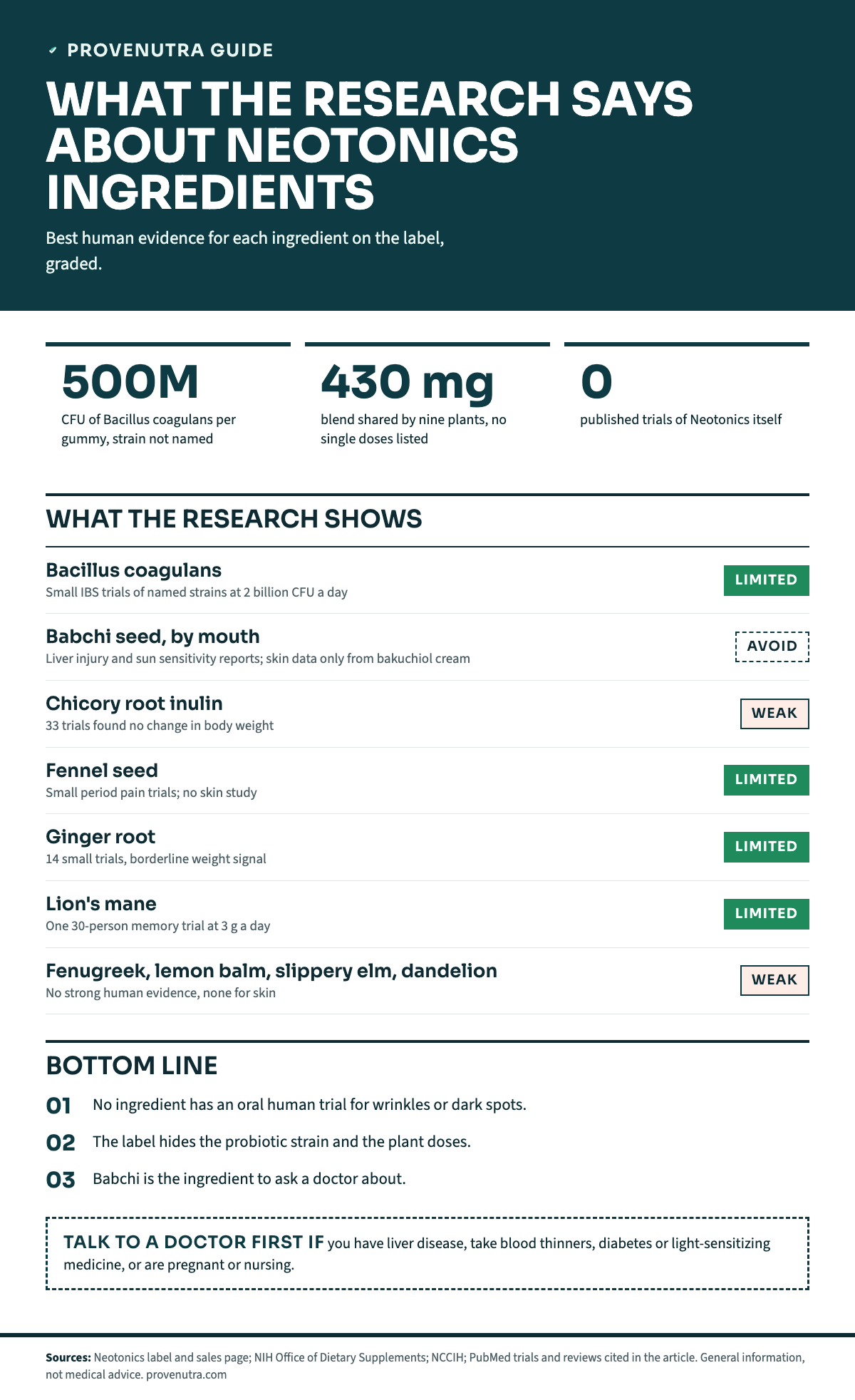
Each Neotonics gummy holds 500 million CFU of Bacillus coagulans and a 430 mg proprietary blend of nine plants, with every plant amount hidden. Spread evenly, 430 mg would be about 48 mg per plant, which is far below the amounts used in most of the human studies below[3].
The gummy base adds glucose syrup, sucrose, apple pectin, natural flavors and black carrot extract for color, and each gummy has 4 calories and 1 g of sugar[3]. The sales page calls the ginger and lion’s mane organic; the label does not[1][3]. Trust the label on the bottle you receive.
| Ingredient | Best human evidence | Skin evidence by mouth | Grade |
|---|---|---|---|
| Bacillus coagulans | Small IBS trials of named strains at about 2 billion CFU a day[8][9] | None; one cream study only[10] | Limited |
| Babchi seed | Bakuchiol creams, not the swallowed seed[11][12] | None | Avoid |
| Chicory root inulin | 33 trials, no change in body weight[15] | None | Weak |
| Fennel seed | Small period pain trials[16] | None | Limited |
| Fenugreek | Not enough evidence, per NCCIH[18] | None | Weak |
| Ginger root | 14 small weight trials, borderline result[19] | None | Limited |
| Lemon balm | Large memory trial missed its main goal[22] | None | Weak |
| Lion’s mane | One 30-person memory trial at 3 g a day[23] | None | Limited |
| Slippery elm | Uncontrolled multi-herb gut studies[24] | None | Weak |
| Dandelion | No compelling evidence, per NCCIH[25] | None | Weak |
Bacillus coagulans
This spore-forming probiotic has the most human data on the label, all of it for gut symptoms. In a 2016 pilot trial, 36 adults with diarrhea-type IBS took the MTCC 5856 strain at 2 billion CFU a day for 90 days, and bloating, diarrhea and pain fell compared with placebo[8]. A 2019 trial of 136 adults with IBS found less pain with the Unique IS2 strain over 8 weeks[9]. Both strains are named; the Neotonics strain is not, and its 500 million CFU is a quarter of the dose in the first trial[3].
The only skin trial tied to this species used a cream, not a pill. Fifty-six women applied a cream with LactoSporin, a product made from the bacteria, for 10 weeks and had fewer visible wrinkles, while skin elasticity and hydration did not differ from placebo[10]. The authors worked for the company that makes it.
Babchi (Psoralea corylifolia seed)
Babchi is the source of bakuchiol, a skincare ingredient sold as a gentle retinol alternative. In a 2019 trial of 44 adults, 0.5% bakuchiol cream reduced wrinkles about as well as 0.5% retinol over 12 weeks[11]. A 2024 review of 15 bakuchiol studies found most were open-label and concluded that the trials “lack methodologic rigor”[12]. All of that work was on the skin surface. We found no trial showing that eating babchi seed changes wrinkles.
Swallowed babchi carries real safety reports. A 53-year-old woman died of acute liver failure after about 7 months of tablets containing the seed[13], and a child had a severe phototoxic skin reaction after using the seeds[14]. The amount in Neotonics is hidden, so the risk at this dose cannot be judged.
Chicory root inulin
Inulin is a prebiotic fiber that feeds gut bacteria. A meta-analysis of 33 trials found that inulin-type fibers did not change body weight, and lowered blood sugar and cholesterol mainly in people with diabetes[15]. Those trials used grams of fiber a day, not a share of a 430 mg blend.
Fennel seed
Fennel is best studied for period pain. A 2020 meta-analysis of 12 trials found less pain than placebo but warned of likely publication bias[16]. Fennel naturally contains estragole, and a food safety study flagged regular use of concentrated fennel products as a concern[17]. No study tested fennel for skin aging.
Fenugreek
NCCIH says there is not enough evidence to judge fenugreek for most uses, that large doses may cause a harmful drop in blood sugar, and that it is not safe in pregnancy above food amounts[18]. No skin trial was found.
Ginger root
A 2019 meta-analysis of 14 small trials in 473 adults with overweight found a small drop in body weight, with a confidence interval that nearly touched zero[19]. NCCIH says ginger has been used safely in many studies, with heartburn and stomach upset as common side effects[20]. It appears on a review list of herbs linked to higher bleeding risk with warfarin[21].
Lemon balm
The largest lemon balm trial followed 323 older adults for 96 weeks and found no significant difference in memory scores on its main measure[22]. Smaller studies look at sleep and calm. There is no wrinkle study.
Lion’s mane
In a 2009 trial, 30 older Japanese adults with mild memory problems took 3 g a day of lion’s mane powder for 16 weeks and scored higher on memory tests, but the gains faded 4 weeks after stopping[23]. That dose is roughly 60 times the 48 mg average per plant in this gummy. No skin study was found.
Slippery elm and dandelion
Slippery elm has no placebo-controlled trial on its own; one 31-person IBS study tested two multi-herb formulas without a control group[24]. NCCIH says there is no compelling scientific evidence for dandelion for any health condition[25]. Neither has skin data.
See the current Neotonics price
Does Neotonics work for wrinkles, collagen and skin elasticity?
No published study shows that Neotonics improves wrinkles, collagen or skin elasticity. No trial has tested the product, and none of its ten ingredients has an oral human trial for skin aging. The skin data that exist come from creams: bakuchiol from babchi and a Bacillus coagulans product applied to the face[10][11].
That gap matters for the anti-aging pitch. A cream acts on the skin it touches. A gummy has to survive digestion, and its contents have to reach the skin in useful amounts. Nothing on the label or the reference page shows that happens with these ingredients[3].
Collagen is a good example. Searches for “collagen Neotonics” are common, yet the label lists no collagen, no vitamin C and no other nutrient tied to collagen building[3]. The vendor’s ingredient tiles say babchi “supports collagen production,” but the only human data behind that idea are from bakuchiol applied to the skin[1][11].
Clear skin is a similar story. Some people link gut health to acne or redness, and research on this is active. Still, the probiotic trials we found measured bowel symptoms, not skin, and they used named strains at higher counts[8][9]. If your main goal is fewer fine lines, a retinoid or bakuchiol cream plus daily sunscreen has more direct evidence than any swallowed blend.
Can Neotonics help with digestion or weight?
Neotonics may cause mild changes in digestion for some people, but the evidence for its weight claim is weak. The fiber, probiotic and gut herbs have small or uncontrolled studies for bowel symptoms, and the two ingredients tested for weight, inulin and ginger, showed no effect or a borderline one[15][19].
On digestion, Bacillus coagulans has the best case, from small trials of named strains[8][9]. The other gut herbs, slippery elm and dandelion, rest on uncontrolled or very small studies[24][25]. A healthy person may notice some change in bowel habits from a new probiotic and fiber, but the label gives too little information to predict it.
On weight, the bottle’s “Healthy Weight” icon is out of place on a skin product, and the testimonials about lost dress sizes are not evidence[1][3]. If weight is your real goal, our Mitolyn review with its weight-loss evidence shows how weak most weight supplement data are, and why diet and activity changes come first.
What are the Neotonics side effects, and who should skip it?
Most healthy adults are likely to notice little more than gas or a change in bowel habits, but babchi seed makes Neotonics a poor fit for some people. Babchi has been linked to liver injury and sun sensitivity, and other ingredients can affect blood sugar, bleeding and absorption of medicines[13][14][18][21].
- Liver disease or heavy drinking: babchi seed has case reports of acute hepatitis and one death from liver failure[13]. Stop and see a doctor if you notice dark urine, yellow eyes or skin, or pain under the right ribs.
- Light-sensitizing drugs or treatments: babchi contains psoralens, which raise sensitivity to sunlight[14]. Be careful if you take tetracyclines, some diuretics or retinoid pills, or get light therapy.
- Blood thinners: ginger is on a review list of herbs linked to more bleeding with warfarin[21].
- Diabetes medicine: NCCIH warns that large fenugreek doses can drop blood sugar too far[18].
- Pregnancy and nursing: NCCIH calls fenugreek unsafe in pregnancy above food amounts[18], and fennel products raise estragole concerns[17].
- Weak immunity or serious illness: NCCIH reports rare serious infections from probiotics in these groups[6].
- Ragweed or daisy allergy: dandelion belongs to that plant family, and NCCIH notes allergic reactions[25].
The vendor’s FAQ says the gummy is “designed for all ages and medical conditions”[4]. The label itself tells anyone under a doctor’s care, on medicine, pregnant or nursing to ask a doctor first[3]. Go with the label.
If you take any daily medicine, show the label to your pharmacist before the first gummy. Ask specifically about babchi, since most people have never heard of it.
See the current Neotonics price
What is the Neotonics price, and is there a discount?
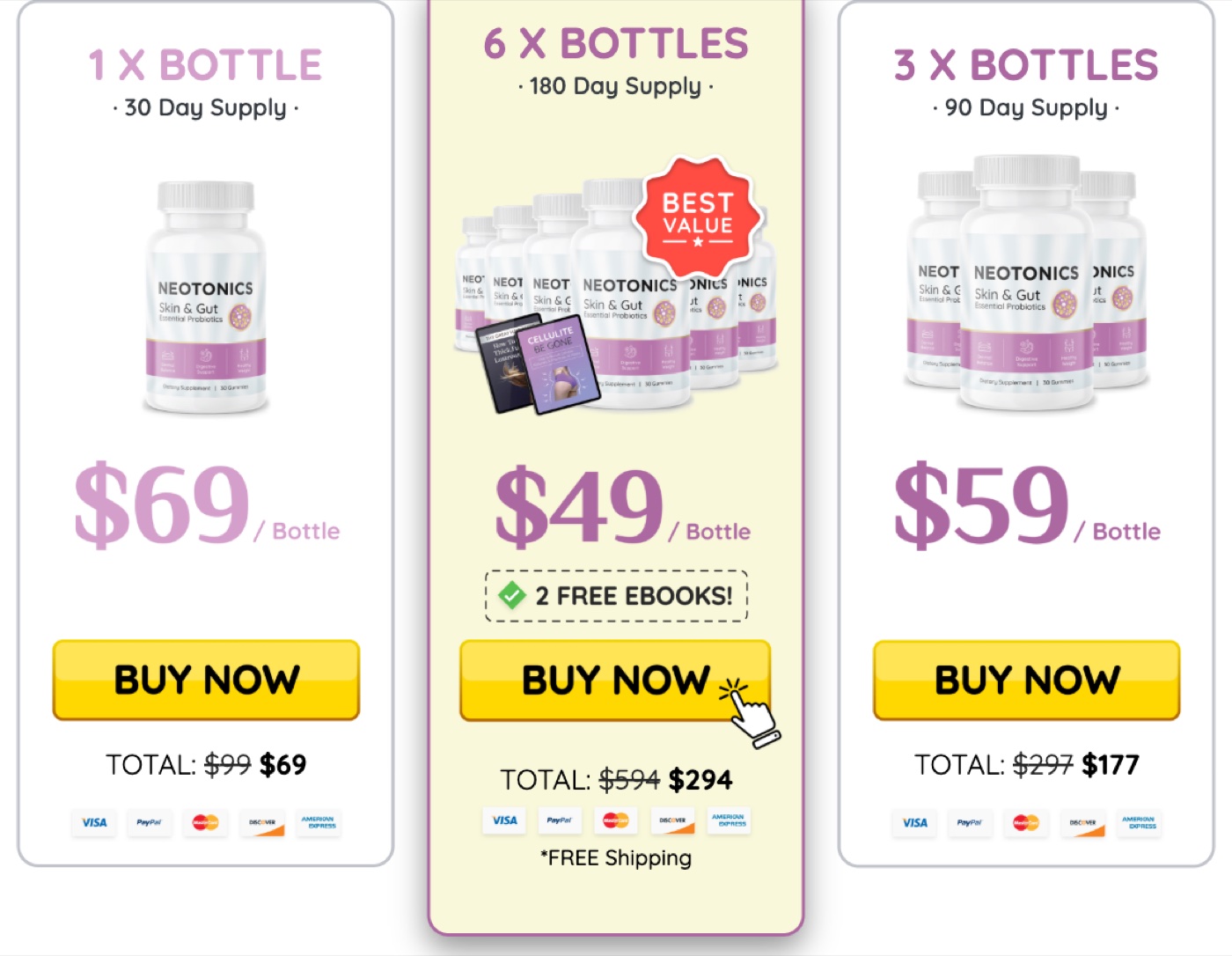
Neotonics costs $69 for one bottle, $177 for three and $294 for six, so the lowest price is $49 a bottle on the 6-bottle package. These are the vendor’s own discounts from its listed “was” prices of $99, $297 and $594; we found no separate coupon code[1].
Lowest price per bottle
6 bottles
$49 a bottle
$294 total, 180-day supply, free US shipping
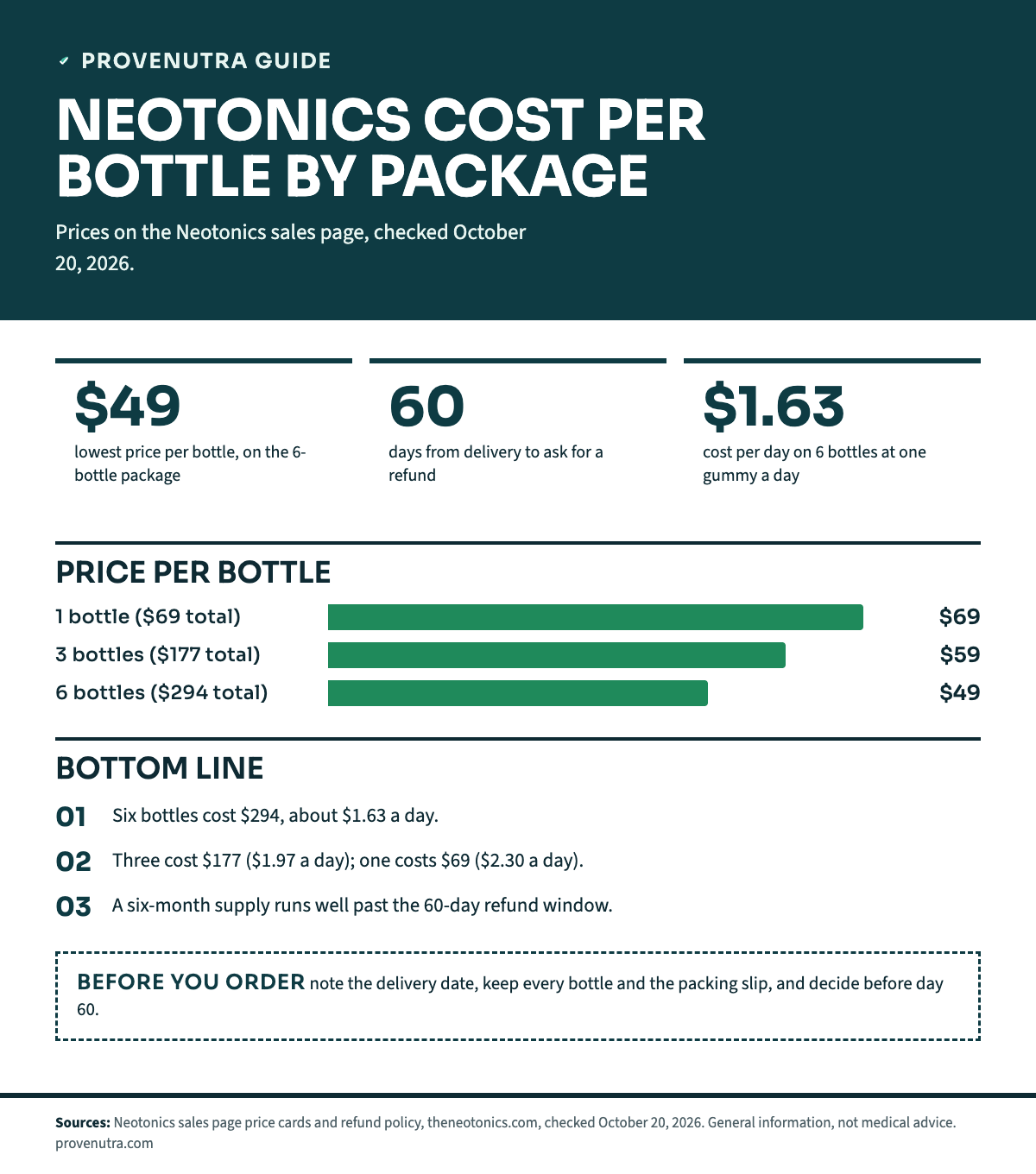
At one gummy a day, that works out to about $2.30 a day on one bottle, $1.97 on three and $1.63 on six[1]. The price grid marks free shipping on the 6-bottle box, while the vendor’s shipping table lists free US shipping, 5 to 7 working days, on all orders[1][4]. Check the total on the checkout page before you pay.
Six bottles also come with two ebooks, one on cellulite and one on hair[1]. After checkout, BuyGoods shows extra bottle offers at $29 each[1]. Those are optional. Decline any you did not plan for.
The 6-bottle deal has a catch. It is a 180-day supply, but the refund window closes 60 days after delivery[1][2]. If you are unsure, the lowest-risk way to try Neotonics is:
- Buy one bottle, or three if you want the lower per-bottle price and accept a bigger return.
- Write down the delivery date from the tracking email.
- Set a reminder for day 45, so you have time to email and post the return.
- Keep the packing slip and every bottle, even empty ones.
- Take a dated photo of your skin on day 1 and day 45 in the same light, so you judge change by more than memory.
Does Neotonics have a money-back guarantee?
Yes. Neotonics gives you 60 days from the day your order is delivered to ask for a refund, but you must mail back every bottle and pay the return postage. The refund policy page says the money reaches your card 5 to 10 days after the return is processed[2].
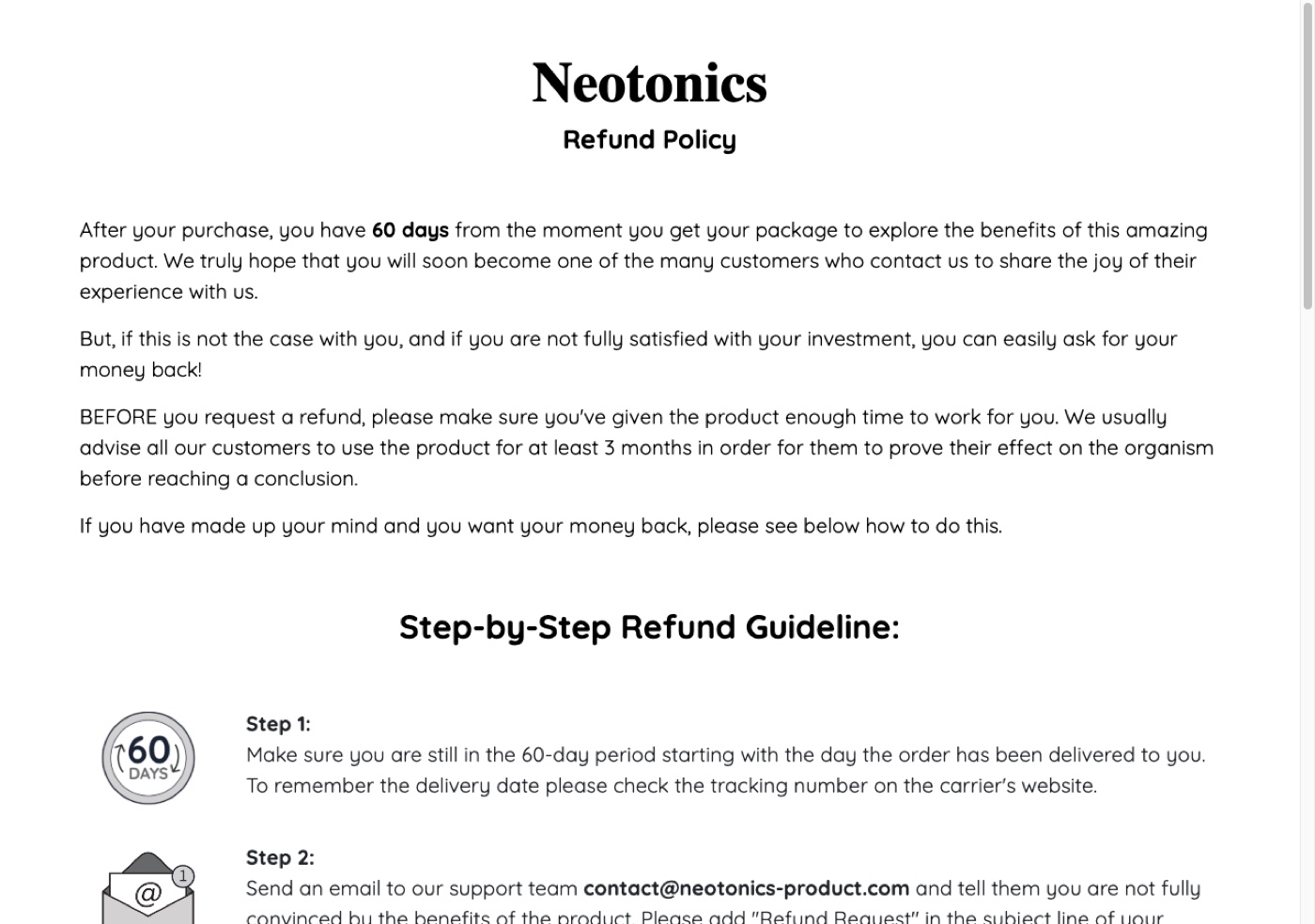
The steps, in the order the policy gives them[2]:
- Confirm you are still inside 60 days of the delivery date shown in tracking.
- Email contact@neotonics-product.com with “Refund Request” in the subject line.
- Mail all bottles, opened or empty, with the packing slip and a note giving your full name, email and order number, to 11870 62nd St N, Largo, FL 33773.
- Wait for the refund, which the policy says shows on your card 5 to 10 days after processing.
Two parts of the vendor’s own pages pull against each other. The FAQ says you can return what you have not used for a refund with no questions asked, but the refund page asks for all bottles[2][4]. The refund page also suggests using the product for at least 3 months before deciding, which runs past the 60-day window[2]. Follow the 60-day deadline, not the 3-month advice. Order problems can also go through BuyGoods, which processed the payment[1].
Where to buy Neotonics safely?
Buy Neotonics on the vendor’s own site, theneotonics.com, where BuyGoods takes the payment and the 60-day refund applies. The FAQ says the product is not sold anywhere else, and we did not check marketplace listings[4].
Copies on marketplaces or resale sites fall outside the vendor’s refund policy. You also cannot check how they were stored or whether the label matches the one the vendor publishes. Some third-party Neotonics pages show an FDA approval badge; ignore it, since the FDA does not approve supplements and the vendor’s own footer says its statements were not evaluated by the FDA[1].
Payment is one-time, not a subscription, according to the FAQ[4]. Product questions go to contact@neotonics-product.com; there is no phone line[4].
What do Neotonics reviews and complaints show?
We could not find independent Neotonics reviews or complaint data that we could read and verify. The star rating and review count on the sales page name no platform, the Better Business Bureau profile we found would not load, and Trustpilot pages were blocked when we checked on October 19, 2026[1][26].
The BBB search returned one “Neotonics” business profile, listed as ecommerce in Aurora, Colorado[26]. That city does not match the Largo, Florida address on the label, and the profile page itself returned an error, so we could not see a rating or complaint count[3][26]. We do not know if it is the same company.
The sales page testimonials are marked as verified purchases but give no platform or date, and the footer says they may not reflect a typical buyer’s results[1]. We did not copy them. Some of them describe weight loss, which is not what a skin gummy is sold for. If you read reviews elsewhere, give more weight to ones that mention dates, delivery times and how a refund went than to before-and-after claims.
Is Neotonics legit as a business? It runs through a known retailer, posts a written refund policy, prints a full ingredient list and states that its claims are not evaluated by the FDA[1][2][3]. Those are basic signs of a real seller. They say nothing about whether the gummy works for skin.
Are there cheaper evidence-based options for skin and gut health?
For wrinkles and skin tone, daily broad-spectrum sunscreen and a retinoid or bakuchiol cream have more human evidence than any skin gummy. For gut health, a fiber-rich diet and, if needed, a probiotic with a named strain matched to a trial give you more to go on[5][11].
- Skin aging: a 0.5% bakuchiol cream matched 0.5% retinol for wrinkles in a 12-week trial, with less stinging[11]. Store brands cost less than one bottle of Neotonics.
- Gut symptoms: look for a probiotic that names its strain and dose on the label, then check that strain against the trials, as NIH ODS advises[5].
- Fiber: beans, oats, onions and chicory-based foods supply inulin in gram amounts, far more than a gummy blend can hold[15].
- Persistent skin or bowel problems: see a dermatologist or doctor. Acne, rosacea and IBS have tested options.
If you are still deciding on supplements more broadly, our guide to checking whether Mitolyn is legit walks through the same retailer, refund and label checks used here. You can also browse our skincare and anti-aging guides.
Who is Neotonics best for?
Neotonics suits a healthy adult who is curious about a gut-focused gummy, takes no regular medicine, and is willing to track a 60-day refund deadline. It is a poor fit for anyone who wants proven wrinkle results or has liver disease, light sensitivity, pregnancy, diabetes medicine or blood thinners in the picture[2][13][14][18][21].
Our honest read: the label is fuller than many in this category, the refund terms are written down, and the price drops to $49 a bottle on six[1][2][3]. Against that, no trial supports the skin claims, the doses are hidden, and babchi brings a safety question the sales page skips. For most people chasing smoother skin, sunscreen and a bakuchiol or retinoid cream are the better first step because they act where the wrinkles are. If you still want to try Neotonics, start small, keep every bottle and decide before day 60.
If you decide to try it
Neotonics: from $49 a bottle
- $69, $177 or $294 for 1, 3 or 6 bottles
- 60 days from delivery to request a refund
- All bottles go back, return postage paid by you
- Ask a doctor first if you take daily medicine
Prices checked October 20, 2026 on theneotonics.com. Affiliate link.
Frequently asked questions
Where can I buy Neotonics?
Buy it on the vendor's site, theneotonics.com, where BuyGoods processes the payment. That is the route the 60-day refund policy covers. Marketplace copies fall outside the policy, and you cannot check how they were stored or whether the label matches.
Does Neotonics have a money-back guarantee?
Yes. You have 60 days from the delivery date to email a refund request. You must mail back every bottle, opened or empty, with the packing slip, and you pay return postage. The policy says the refund reaches your card 5 to 10 days after processing.
What are the Neotonics side effects?
Most healthy adults may notice gas or a change in bowel habits. The bigger concern is babchi seed, linked in case reports to liver injury and sun sensitivity. Ginger and fenugreek can matter for people on blood thinners or diabetes medicine, so ask a doctor first.
How do you take Neotonics?
The label says adults take one gummy a day, about 30 minutes before a morning or afternoon meal, with a full glass of water. Each bottle holds 30 gummies, a 30-day supply. Do not take more than the label directs.
How long before Neotonics shows results, per the vendor?
The refund page advises using it for at least 3 months before judging it, which is longer than the 60-day refund window. No trial of the product shows any timeline for skin changes. If you try it, decide before day 60.
Is Neotonics legit?
It is sold through BuyGoods, a known retailer, with a written 60-day refund policy, a full ingredient list and the standard FDA disclaimer. Those are signs of a real seller. No trial shows the gummy improves wrinkles, and the blend doses are hidden.
Sources
- Neotonics sales page and price grid. Neotonics (vendor), read October 19 and 20, 2026
- Neotonics refund policy. Neotonics (vendor), read October 20, 2026
- Neotonics references and Supplement Facts label. Neotonics (vendor), label REV 08/25, read October 19, 2026
- Neotonics contact page, FAQ and shipping table. Neotonics (vendor), read October 19, 2026
- Probiotics: Fact Sheet for Consumers. NIH Office of Dietary Supplements, archived October 2026
- Probiotics: Usefulness and Safety. NCCIH, read October 2026
- Health Products Compliance Guidance. Federal Trade Commission, archived October 2026
- Bacillus coagulans MTCC 5856 for diarrhea-predominant IBS: pilot RCT (Majeed). Nutrition Journal, 2016
- Bacillus coagulans Unique IS2 in adults with IBS: RCT (Madempudi). Scientific Reports, 2019
- Topical LactoSporin cream for facial wrinkles: RCT. Journal of Cosmetic Dermatology, 2023
- Bakuchiol vs retinol for photoaging: RCT (Dhaliwal). British Journal of Dermatology, 2019
- Bakuchiol in dermatology: systematic review (Fanning). Systematic review, 2024
- Fatal acute liver failure after Fructus Psoraleae tablets (Li). Case report, 2019
- Severe phototoxic reaction to Psoralea corylifolia seeds in a child. Case report, 2024
- Inulin-type fructans and cardiometabolic health: meta-analysis of 33 RCTs. Meta-analysis, 2021
- Fennel for primary dysmenorrhea: meta-analysis (Lee). Meta-analysis, 2020
- Estragole content of fennel preparations and exposure assessment. Food safety study, 2014
- Fenugreek. NCCIH
- Ginger and weight in overweight adults: meta-analysis (Maharlouei). Critical Reviews in Food Science and Nutrition, 2019
- Ginger. NCCIH
- Herbs and warfarin: systematic review of bleeding risk. Systematic review, 2020
- Lemon balm extract and cognition over 96 weeks: RCT (Noguchi-Shinohara). RCT, 2023
- Lion's mane for mild cognitive impairment: RCT (Mori). Phytotherapy Research, 2009
- Herbal formulas with slippery elm for IBS: pilot study (Hawrelak). Pilot study, 2010
- Dandelion. NCCIH, archived 2026
- BBB search results: neotonics. Better Business Bureau, read October 19, 2026

Daniel Brooks is the Reviews Editor at ProveNutra. He reads every supplement facts panel line by line, checks each ingredient and dose against human research from the NIH Office of Dietary Supplements, NCCIH, PubMed and the Cochrane Library, and reads the refund policy and checkout terms before a review is published. Daniel is not a doctor, dietitian or pharmacist, and his reviews are not medical advice. He writes pros, cons and who a product suits, never scores. How we review supplements.
This article is general information, not medical advice. Dietary supplements are not reviewed by the FDA for safety or effectiveness before they are sold. Talk to your doctor before you start any supplement, especially if you are pregnant, nursing, take medication or have a health condition.