This article contains affiliate links. If you buy through them we may earn a commission at no extra cost to you, and it never changes what we report. How we make money.
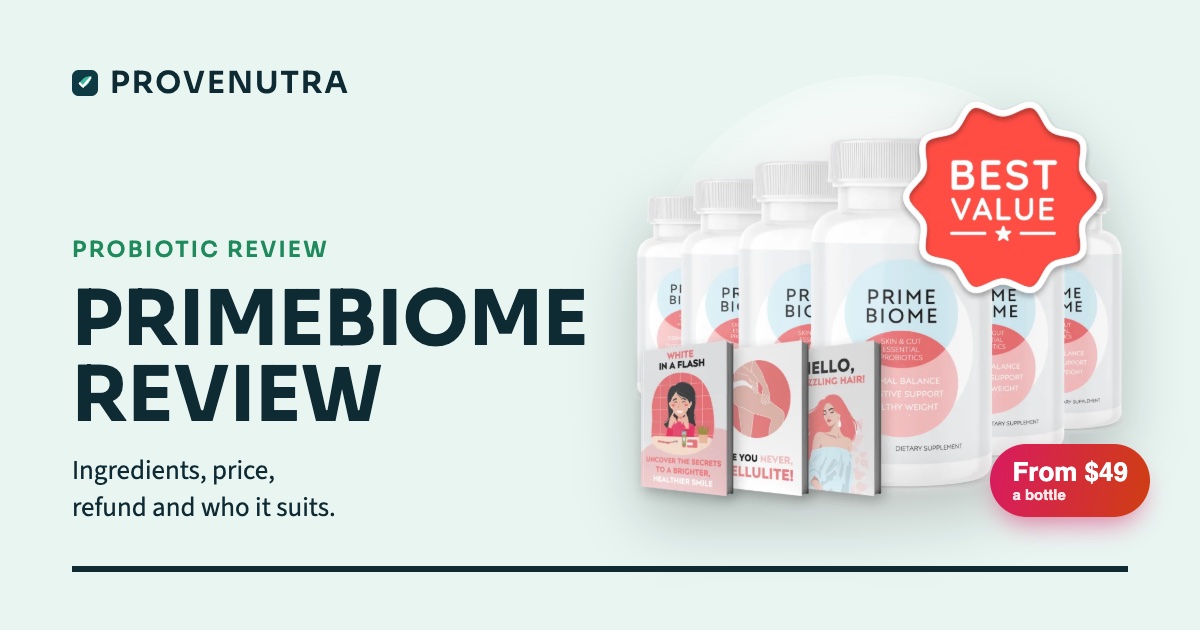
PrimeBiome is a probiotic gummy with nine plant ingredients, sold for $49 to $79 a bottle with a 60-day refund from delivery. No trial has tested it, the strain and blend doses are hidden, and the best skin evidence comes from creams. A healthy adult who tracks the refund deadline can try it at low risk; anyone with liver disease or on regular medicine should ask a doctor first.
On this page
- What is PrimeBiome and what does the vendor claim?
- How is PrimeBiome supposed to work?
- What ingredients are in PrimeBiome?
- Does PrimeBiome work for skin, digestion or weight?
- What are the PrimeBiome side effects, and who should skip it?
- What is the PrimeBiome price on each package?
- Does PrimeBiome have a money-back guarantee?
- Where to buy PrimeBiome: is the official website the only safe place?
- What do PrimeBiome reviews and complaints show?
- Which sales page claims deserve a second look?
- Are there cheaper evidence-based options for gut and skin health?
- Who is PrimeBiome best for?
- FAQ
PrimeBiome pros and cons
What we liked
- 60-day refund window from the delivery date, in a written policy
- Sold through BuyGoods, a known retailer with order support
- One gummy a day with 4 calories and 1 g of sugar
- $49 a bottle on the 6-bottle package with free US shipping
- Bacillus coagulans has some small IBS trials for named strains
Watch out for
- No published trial of the PrimeBiome formula
- Probiotic strain not named and plant doses hidden in a 430 mg blend
- Skin evidence comes from creams, not from swallowing these ingredients
- Babchi seed is linked to sun sensitivity and liver injury reports
- All bottles must be returned and return postage is on the buyer
This PrimeBiome review is based on what we could check on October 19, 2026: the official sales page, the price cards, the refund policy, the Supplement Facts label and the published human research on the probiotic and all nine plant ingredients. ProveNutra reviews editor Daniel Brooks compared each vendor claim with that research and with consumer guidance from the NIH, NCCIH and the FTC. The full method is on our page about how ProveNutra reviews supplements.
It is written for adults weighing a $49 to $79 bottle of probiotic gummies for skin, digestion or weight. ProveNutra earns a commission if you buy through our links; it does not change what we report.
Best price we found
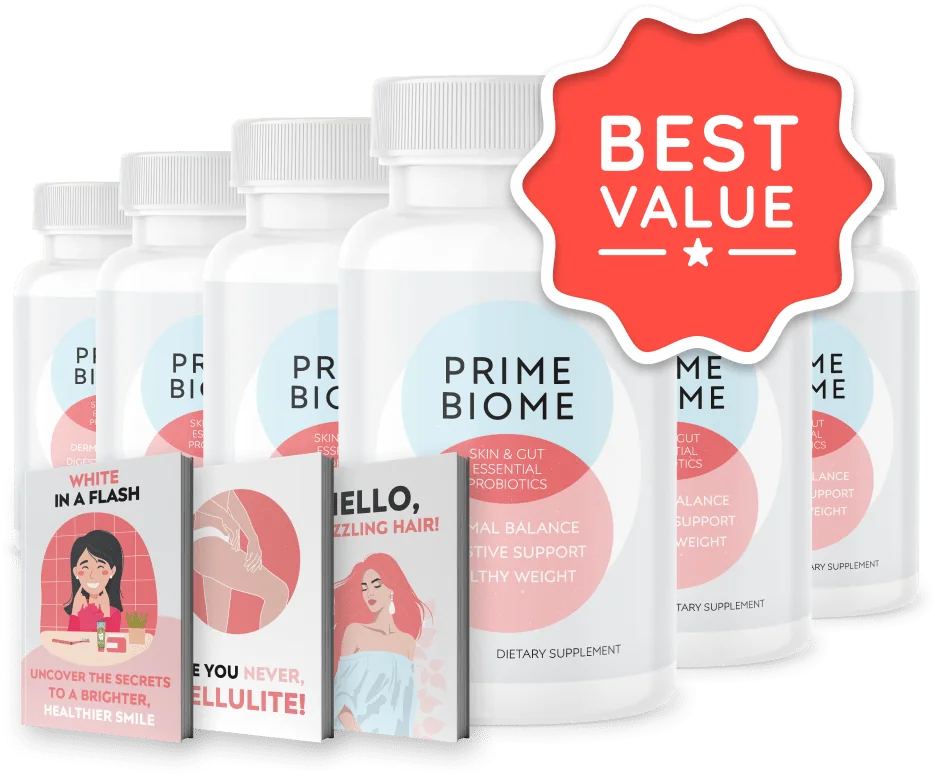
PrimeBiome: $49 a bottle on 6
- One gummy a day, about 30 minutes before a meal, per the label
- One probiotic plus nine plant ingredients, blend doses not listed
- $294 for 6 bottles with free US shipping
- 60 days from delivery to ask for a refund
Check today’s price on the official site
Prices checked October 19, 2026 on theprimebiome.com. Affiliate link.
| What it is | A daily gummy labeled “Skin & Gut Essential Probiotics,” 30 gummies a bottle, sold online with BuyGoods as the retailer[1] |
|---|---|
| Main claim (the vendor’s) | Skin support for wrinkles and dark spots, plus digestive support and healthy weight[1] |
| Ingredients | Bacillus coagulans, chicory root inulin, babchi, fennel, fenugreek, ginger, lemon balm, lion’s mane, slippery elm, dandelion[1] |
| Doses | 500 million CFU of Bacillus coagulans (strain not named); the nine plants share a 430 mg proprietary blend with no single doses[1] |
| Price | $158 for 2 bottles plus shipping, $207 for 3, $294 for 6[1] |
| Guarantee | 60 days from the delivery date; all bottles must be returned[2] |
| Who should avoid it | Pregnant or nursing people, people with liver disease or weak immunity, and anyone on blood thinners, diabetes medicine or light-sensitizing drugs without a doctor’s OK[4][11][12][19] |
What is PrimeBiome and what does the vendor claim?
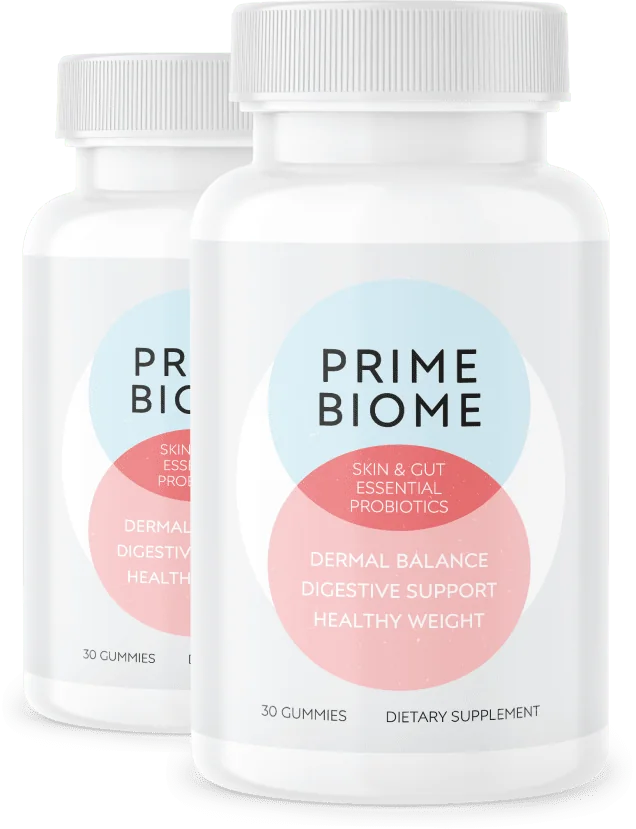
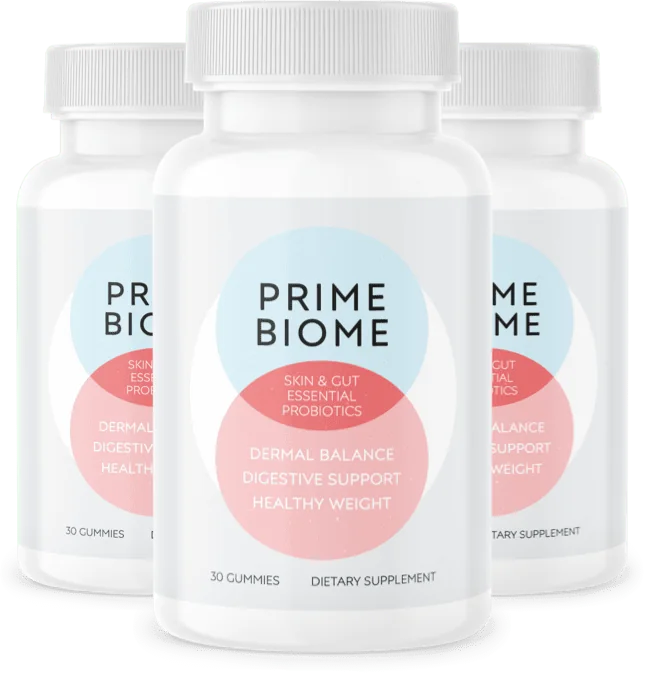
PrimeBiome is a once-a-day gummy that pairs one probiotic, Bacillus coagulans, with nine plant powders and extracts. The front of the bottle promises “dermal balance, digestive support, healthy weight,” and the sales page leans hardest on the skin angle: fewer wrinkles, faded dark spots and firmer skin[1].
When we checked, the headline read “Top Dermatologist: This Blue Antioxidant Might Just Be 10 Times Better Than Retinol (And Can Get You Rid of Dark Spots, Wrinkles & Saggy Skin)”[1]. The dermatologist is not named. The page does not say which ingredient on the label is the blue antioxidant, and the only color additive we found on the label is black carrot extract[1].

Before the video, the page runs a short quiz about your age, skin worries, weight and digestion. It ends by describing a “customized formula,” yet every buyer receives the same gummy[1]. The page also shows a 30-minute countdown timer, a “While Supplies Last” note, a claim of “over 21,000 customers” and a count of 19,479 reviews with no named source[1]. We treat those as marketing, since none of them can be checked.
The label lists BuyGoods as the retailer and a Largo, Florida address for the distributor. It says the gummies are made in the USA in an FDA registered facility[1]. Registration means the plant is on file with the FDA. It is not an approval of the product, and the label carries the standard line that its statements were not evaluated by the FDA[1].
How is PrimeBiome supposed to work?
The vendor’s idea is a gut-skin link: feed the gut friendly bacteria and fiber, and the skin, digestion and weight follow. Researchers do study links between gut microbes and skin, but no study has shown that this gummy changes wrinkles, spots or weight in people.
The reference list under the video mixes PubMed papers with blog posts. The papers include Bacillus coagulans trials in irritable bowel syndrome (IBS), an inulin review and a fenugreek study in mice on a high-fat diet[1]. The rest are consumer articles from sites such as Healthline and a skincare marketing page[1]. None of the references tested PrimeBiome, and none measured wrinkles after people swallowed these ingredients.
Two federal sources frame the probiotic part of the pitch. The NIH Office of Dietary Supplements says “higher CFU counts alone do not necessarily mean that the product has greater health benefits,” because the benefit depends on the exact strain[3]. It adds that there are “no official recommendations that cover the use of probiotics by healthy people”[3]. NCCIH says that “in most instances, we still don’t know which probiotics are helpful and which are not”[4].
That matters here because the label names the species, Bacillus coagulans, but not the strain[1]. The NIH fact sheet says the genus, species and strain should all be on a probiotic label[3]. Without the strain, there is no way to match PrimeBiome to a specific trial.
What ingredients are in PrimeBiome?
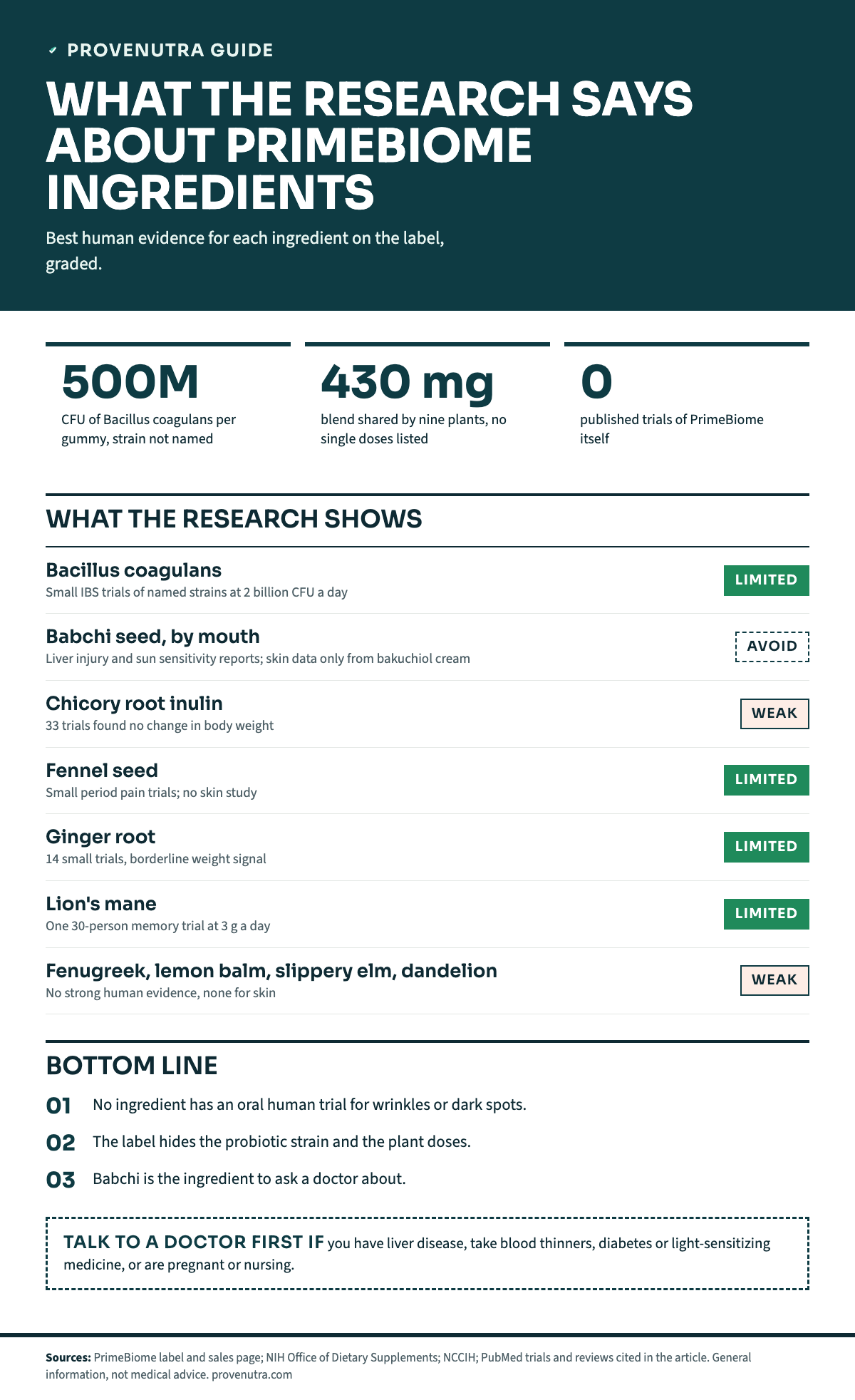
Each gummy holds 500 million CFU of Bacillus coagulans and a 430 mg blend of nine plants: chicory root inulin, babchi, fennel, fenugreek, ginger, lemon balm, lion’s mane, slippery elm and dandelion leaf. The label hides how much of each plant is in the blend, so no single dose can be compared with a study[1].
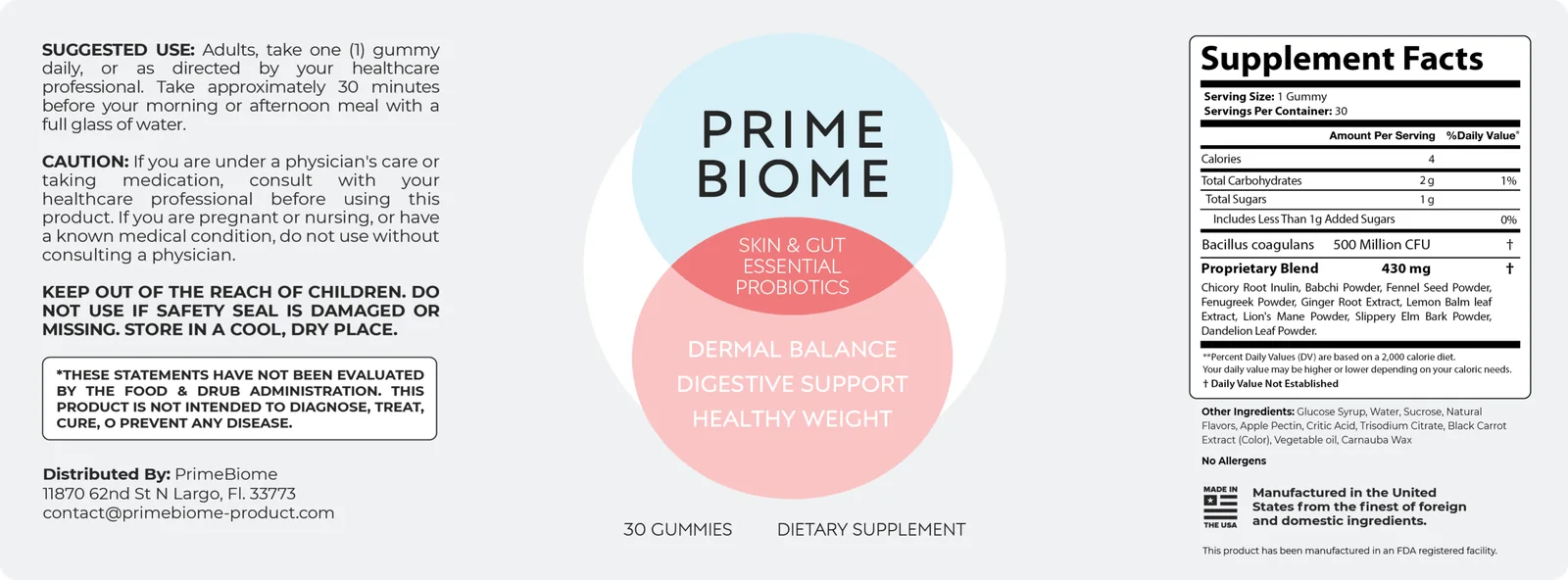
Each gummy also has 4 calories, 2 g of carbohydrate and 1 g of sugar, from glucose syrup and sucrose[1]. Here is how the human research on each ingredient stacks up.
| Ingredient | Best human evidence | Skin evidence | Grade |
|---|---|---|---|
| Bacillus coagulans | Small IBS trials of named strains[6][7] | Topical cream of a metabolite only[8] | Limited |
| Chicory root inulin | 33 RCTs: no change in body weight[13] | None found | Weak |
| Babchi | Liver injury and light-sensitivity case reports[11][12] | Topical bakuchiol only[9][10] | Avoid (oral) |
| Fennel seed | Small period-pain trials[14] | None found | Limited |
| Fenugreek | Not enough for diabetes, per NCCIH[16] | None found | Weak |
| Ginger root | Small, borderline weight signal[17] | None found | Limited |
| Lemon balm | 96-week trial missed its main goal[20] | None found for wrinkles | Weak |
| Lion’s mane | One 30-person memory trial[21] | None found | Limited |
| Slippery elm | Uncontrolled multi-herb studies[22] | None found | Weak |
| Dandelion leaf | No compelling evidence, per NCCIH[23] | None found | Weak |
Bacillus coagulans
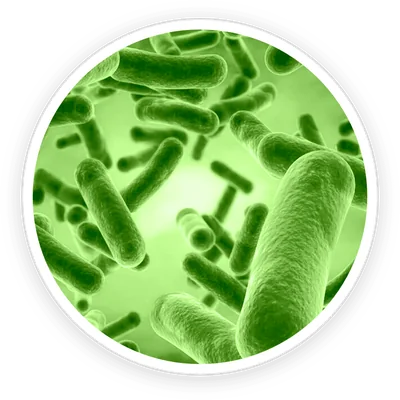
This is a spore-forming probiotic, which helps it survive storage and stomach acid. In a 2016 pilot trial, 36 adults with diarrhea-type IBS took 2 billion CFU a day of the MTCC 5856 strain for 90 days, and bloating, diarrhea and pain fell more than on placebo[6]. A 2019 trial of the Unique IS2 strain in 136 adults with IBS improved pain and bowel movements over 8 weeks[7]. Both were small and funded by the strain makers. PrimeBiome lists 500 million CFU, a quarter of the dose in the first trial, and does not name its strain[1].
For skin, the only human trial we found used a cream made from a Bacillus coagulans metabolite, not live bacteria. In 56 women over 10 weeks, dermatologists saw fewer visible wrinkles, but instrument readings of elasticity and hydration did not beat placebo, and every author worked for the maker[8].
Chicory root inulin
Inulin is a prebiotic fiber that feeds gut bacteria. A meta-analysis of 33 randomized trials found that inulin-type fiber did not change body weight; it lowered blood sugar and cholesterol only in people with diabetes[13]. Fiber trials use grams a day, far more than could fit in a 430 mg blend shared with eight other plants[1][13].
Babchi (Psoralea corylifolia)
Babchi seed is the source of bakuchiol, the plant compound tested against retinol. In a 2019 trial, 44 adults applied 0.5% bakuchiol cream twice daily or 0.5% retinol daily for 12 weeks; both cut wrinkle area and dark spots by similar amounts, and retinol caused more stinging[9]. That was a cream on the skin. A 2024 review of 15 bakuchiol trials found that 12 had no control group and concluded the trials “lack methodologic rigor”[10].
Swallowing the seed is a different matter. Babchi seeds contain psoralens, which make skin more sensitive to sunlight, and a child using the seeds had a severe light-triggered skin reaction[12]. The seeds are also linked to liver injury, including a woman who died of liver failure after about 7 months of tablets containing them[11]. The label does not say how much babchi each gummy holds[1].
Fennel seed
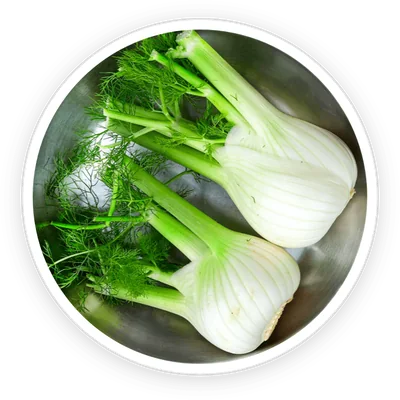
Fennel is mostly studied for period pain. A 2020 meta-analysis of 12 trials found less pain than placebo, but the authors flagged likely publication bias from many small positive studies[14]. We found no human skin study. Fennel contains estragole, a compound that causes cancer in rodents; one analysis measured 0.15 to 13.3 mg per gram in fennel products and raised concern about regular use[15].
Fenugreek
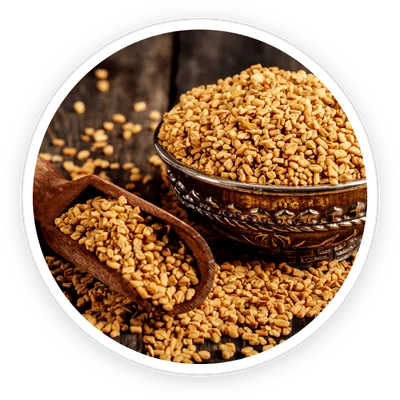
The fenugreek paper in the vendor’s own reference list was a mouse study[1]. NCCIH says there is not enough evidence to support fenugreek for diabetes, that large doses may cause a harmful drop in blood sugar, and that it is not safe in pregnancy above food amounts[16].
Ginger root
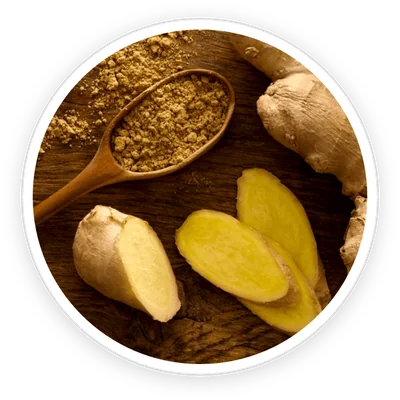
A 2019 meta-analysis of 14 small trials in 473 adults with overweight found a modest drop in body weight with ginger, but the confidence interval almost touched zero and BMI did not change[17]. NCCIH notes ginger has been used safely in many studies, with heartburn and stomach upset as the common complaints[18].
Lemon balm
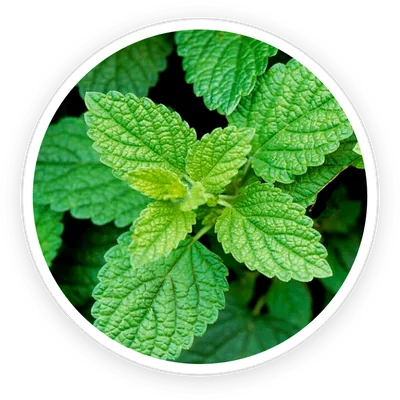
Lemon balm is studied for calm, sleep and memory. Its largest trial gave 323 older adults an extract for 96 weeks and found no difference on the main memory measures[20]. We found no human study of lemon balm for wrinkles.
Lion’s mane
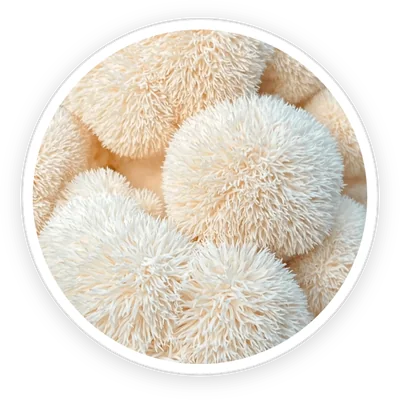
Lion’s mane is an edible mushroom. In a 2009 trial, 30 Japanese adults with mild memory decline took 3 g a day for 16 weeks and scored higher on memory tests than the placebo group, with scores falling again after they stopped[21]. That is roughly seven times the size of the entire PrimeBiome blend[1]. We found no skin study.
Slippery elm
Slippery elm bark forms a gel in water and is used for sore throats and bowel complaints. We found no placebo-controlled trial of slippery elm on its own. A 2010 pilot in 31 people with IBS tested two multi-herb formulas without a placebo group, and only the constipation formula helped[22].
Dandelion leaf
NCCIH says “there’s no compelling scientific evidence supporting the use of dandelion for any health condition”[23]. It also warns that dandelion may interact with diabetes medicine, blood thinners and water pills[23].
See the current PrimeBiome price
Does PrimeBiome work for skin, digestion or weight?
No trial has tested PrimeBiome itself, so nobody can say what the gummy does for skin, digestion or weight. The ingredient research gives a weak signal for gut symptoms, no oral evidence for wrinkles or dark spots, and no meaningful support for weight loss.
For skin, the strongest data come from creams. Bakuchiol cream matched retinol cream in one 44-person trial[9], and a Bacillus coagulans metabolite cream reduced visible wrinkles in one maker-run trial[8]. Neither tells us what happens when the same ingredients are swallowed in a gummy at an unknown dose. NCCIH also notes there has been “very little research in people on probiotics for acne”[4].
For digestion, specific Bacillus coagulans strains helped IBS symptoms in small trials at 2 billion CFU or more[6][7]. NCCIH says a 2018 review of 53 probiotic trials for IBS could not “draw definite conclusions” about which strains help[4]. PrimeBiome offers a smaller, unnamed strain[1].
For weight, the NIH fact sheet says some probiotic studies found a slight drop in weight while others found “no effect or might even increase body weight”[3]. Inulin did not move body weight across 33 trials[13], and ginger’s signal was borderline[17]. The FTC expects health claims to rest on “randomized, controlled human clinical testing”[5], and we found none for this product.
What are the PrimeBiome side effects, and who should skip it?
Most healthy adults would likely notice little beyond mild gas or stomach upset, but babchi seed is the ingredient that needs real caution. It is tied to light sensitivity and to case reports of liver injury, and the label does not disclose how much each gummy holds.
- Liver disease or heavy drinking: skip it. Babchi seed products have been linked to serious liver injury, including one death[11].
- Light-sensitizing drugs or phototherapy: babchi contains psoralens, which raise sun sensitivity[12]. Ask a doctor if you take tetracyclines, isotretinoin or similar drugs.
- Blood thinners: ginger is on a review list of herbs linked to higher bleeding risk with warfarin[19], and NCCIH flags dandelion with blood thinners[23].
- Diabetes medicine: fenugreek may cause a harmful drop in blood sugar in large doses[16], and dandelion may interact with diabetes drugs[23].
- Pregnancy or nursing: fenugreek is not considered safe above food amounts in pregnancy[16], fennel contains estragole[15], and the label itself says to check with a physician[1].
- Weak immunity or serious illness: NCCIH says the risk of harm from probiotics is greater in people with severe illness or a compromised immune system[4].
- Ragweed or daisy allergy: dandelion belongs to that plant family[23].
NCCIH also reminds readers that “few studies have looked at the safety of probiotics in detail”[4]. If you start the gummy and notice yellow skin or eyes, dark urine or a rash after sun exposure, stop and call a doctor.
See the current PrimeBiome price
What is the PrimeBiome price on each package?
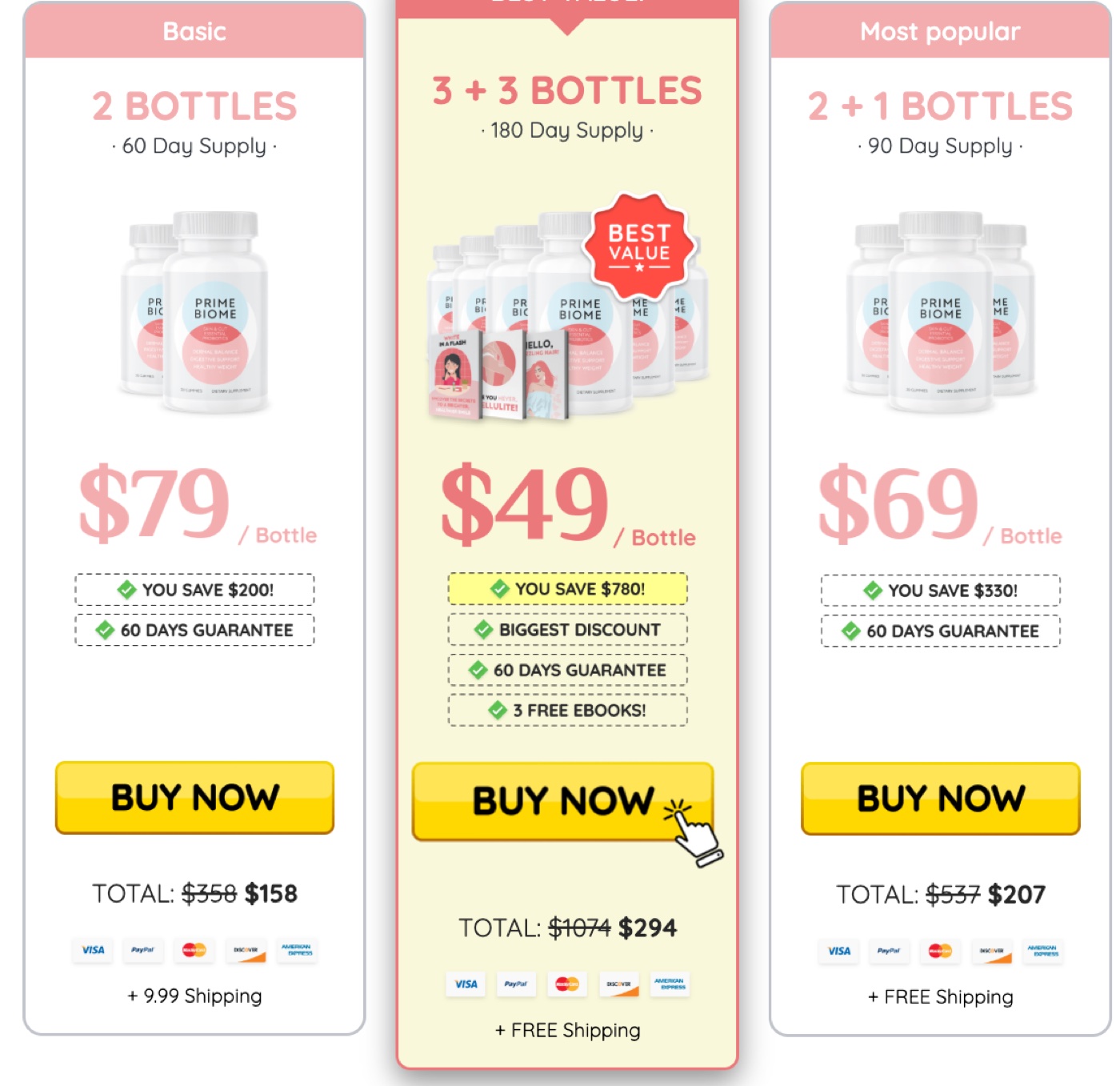
The PrimeBiome price runs from $49 to $79 a bottle, depending on the package. Two bottles cost $158 plus $9.99 shipping, three bottles cost $207 ($69 each), and six bottles cost $294 ($49 each); the 3- and 6-bottle packages ship free in the US. There is no single-bottle option[1].
Lowest price per bottle
6 bottles
$49 a bottle
$294 total, 180-day supply, free US shipping
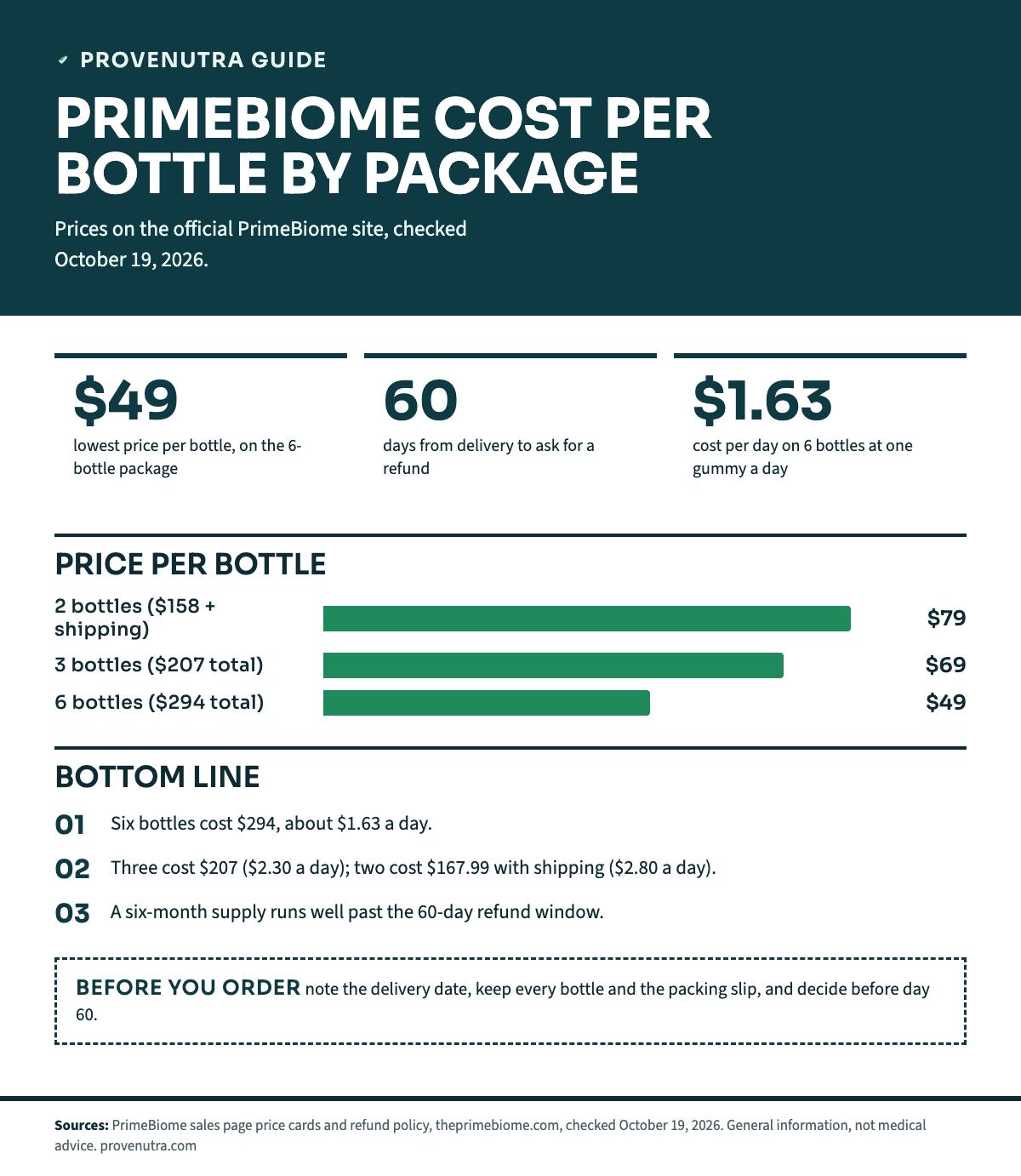
The vendor frames the larger packages as “2+1” and “3+3” bottle bonuses, and the 6-bottle package adds three ebooks[1]. The struck-through totals of $358, $537 and $1,074 are the seller’s reference prices, so we leave them out of the math[1]. International shipping costs extra[1].
| Package | Total paid | Days of supply | Cost per day |
|---|---|---|---|
| 2 bottles | $167.99 with shipping | 60 | $2.80 |
| 3 bottles | $207 | 90 | $2.30 |
| 6 bottles | $294 | 180 | $1.63 |
The cheapest way to test the gummy is the 2-bottle package, but the cost per day is highest there. The 6-bottle package halves the price per bottle, yet the 60-day refund window closes long before the 180-day supply runs out[1][2]. A few steps keep the risk down:
- Write down the delivery date; the 60 days start then, not on the order date[2].
- Set a phone reminder for day 45 to decide whether to keep going.
- Keep the packing slip and every bottle, even empty ones, because the refund requires them[2].
- Save your order confirmation email from BuyGoods.
Does PrimeBiome have a money-back guarantee?
Yes. The refund policy gives you 60 days from the day your package is delivered to ask for your money back. You email the company, then mail back all bottles, opened or not, with the packing slip. Return shipping is on you, and the refund then posts to your card in 5 to 10 days[2].
The policy allows a refund request within 60 days of delivery. You return every bottle, empty or full, and pay the return postage yourself.
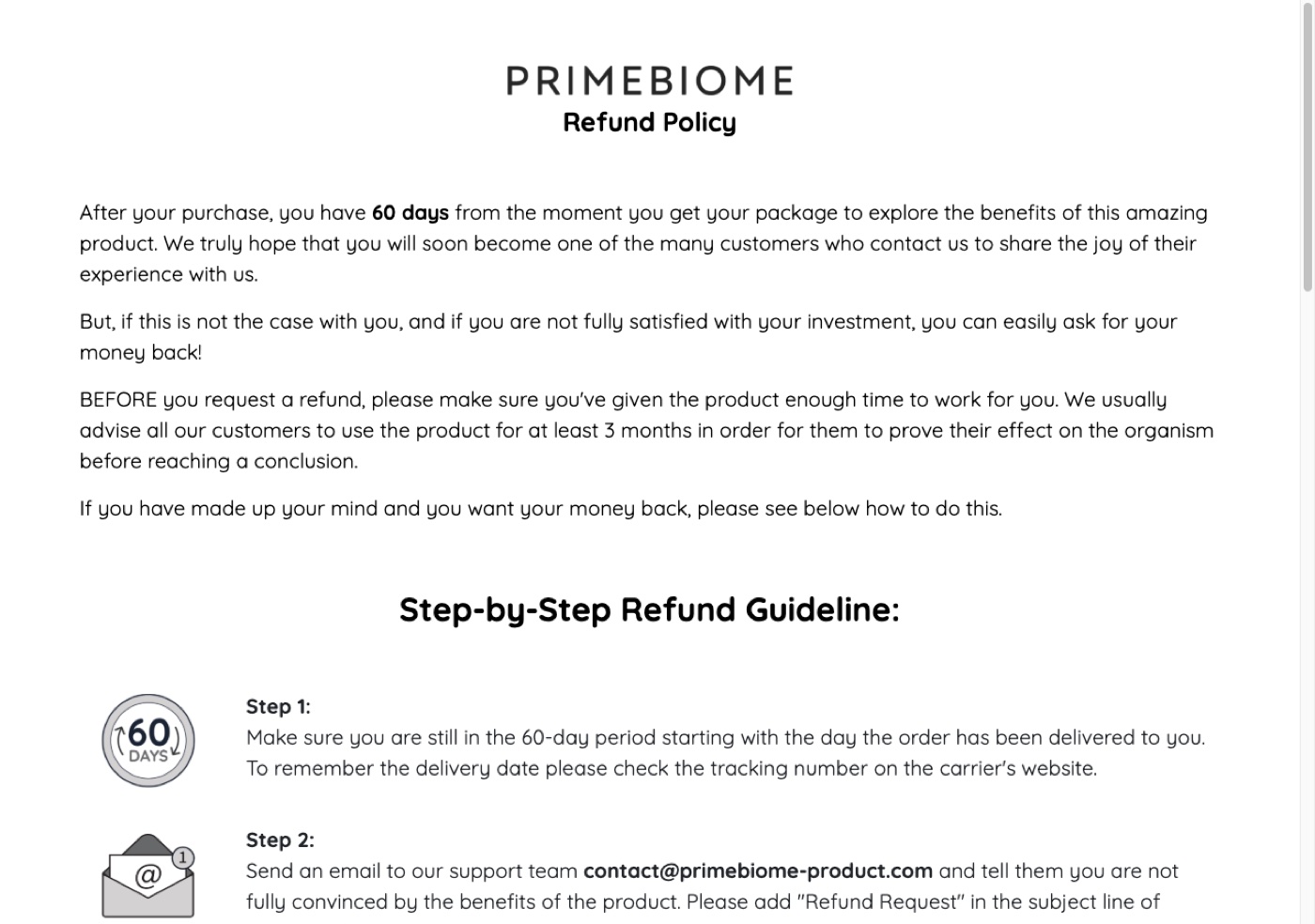
The steps on the policy page are:
- Check that you are still inside 60 days from the delivery date[2].
- Email contact@primebiome-product.com with “Refund Request” in the subject line[2].
- Pack all bottles, empty or not, with the packing slip and a note giving your name, email and order ID[2].
- Mail the box to 11870 62nd St N, Largo, FL 33773, at your own cost[2].
- Watch for the refund on your card 5 to 10 days after it is processed[2].
One line in the policy works against the buyer. It advises using the product for “at least 3 months” before deciding[2]. On a 2-bottle order, three months is longer than both the 60-day supply and the 60-day window. Decide by the deadline, not by the vendor’s suggested trial length.
Where to buy PrimeBiome: is the official website the only safe place?
Buy PrimeBiome on the official website, where BuyGoods processes the order and the 60-day refund policy applies. Marketplace listings from other sellers fall outside that policy, and you cannot check how those bottles were stored or where they came from.
Bing searchers often look for “prime biome official website buy online,” and the order path we checked was a BuyGoods checkout linked from theprimebiome.com[1]. Order lookups and billing questions go through BuyGoods, and refund requests go to the PrimeBiome contact email[1][2]. We explain how to spot a real supplement order page in our guide to the official Mitolyn website and copycat sellers; the same checks apply here.
Copycat bottles carry two risks. A seller outside the official site can refuse a refund, and NCCIH notes that some probiotic products have contained microorganisms other than those on the label[4].
Visit the official PrimeBiome site
What do PrimeBiome reviews and complaints show?
The only star ratings we could see were on the vendor’s own page, which shows 19,479 reviews and three “Verified Purchase” testimonials without saying where they were collected. Independent review sites gave us little to go on, so treat any big rating figure with care[1].
A Better Business Bureau search for “primebiome” returned 286 unrelated businesses and no PrimeBiome profile when we checked on October 19, 2026[24]. Trustpilot blocked our request, so we do not report any figures from it. The testimonials on the sales page come from Sophia in Kentucky, Carrie in Georgia and Eleanor in New Jersey; the page does not show whether their results are typical[1].
Complaints about this kind of product tend to center on refunds, so read the terms above before you order. For a worked example of how we sort real complaints from noise, see our look at Mitolyn reviews and complaints, which uses the same sources.
Which sales page claims deserve a second look?
Three claims on the PrimeBiome page go further than the evidence: the retinol comparison, the “customized formula” quiz and the urgency cues. Each is a common sales tactic, and none is backed by a published PrimeBiome trial.
- “10 Times Better Than Retinol”: the best bakuchiol trial found a cream about equal to retinol cream, not ten times better, and it was applied to the skin[9].
- “Customized formula”: the quiz results lead to one product with one label for everyone[1].
- Countdown timer and “While Supplies Last”: these push a fast decision. The FTC says health claims need solid human trials[5], and a timer is not evidence.
- Unnamed “top dermatologist”: no name, license or affiliation appears on the page[1].
We use the same checklist in our piece on whether Mitolyn is legit, if you want to see it applied to a weight loss product.
Are there cheaper evidence-based options for gut and skin health?
Yes. For gut symptoms, a probiotic with a named, studied strain or more fiber from food is a better-supported first step; for wrinkles and dark spots, a skin cream with a tested active is the stronger choice.
- Pick a strain, not a slogan. The NIH fact sheet says to look for the genus, species and strain on the label, and to ask a provider which product and dose fit your problem[3].
- Fermented foods and fiber. Yogurt, sauerkraut and other fermented foods are made with live microorganisms[3], and inulin comes from foods such as chicory root[13].
- Topical creams for skin. Both 0.5% bakuchiol and 0.5% retinol creams reduced wrinkle area and dark spots in a 12-week trial[9].
- See a doctor for ongoing gut trouble. NCCIH says not to use probiotics “as a reason to postpone seeing your health care provider”[4].
Weight loss shoppers can compare this with our Mitolyn review and our breakdown of whether Mitolyn really works, both judged against the same NIH guidance.
Who is PrimeBiome best for?
PrimeBiome suits a healthy adult who wants to try a probiotic gummy, accepts that its skin claims are unproven, and will use the 60-day refund window. It does not suit anyone with liver disease, anyone pregnant or nursing, or anyone on blood thinners, diabetes drugs or light-sensitizing medicine.
The case for it is modest: a spore-forming probiotic species with some IBS research, a one-a-day gummy and a written refund policy[1][2][6]. The case against it is that the strain and blend doses are hidden, the best skin evidence comes from creams, and babchi seed carries liver and sun risks[1][9][11][12]. If you try it, start with the package you can afford to lose, mark the delivery date, and keep every bottle until the window closes.
Best price we found
PrimeBiome: $49 a bottle on 6
- $294 for a 180-day supply with free US shipping
- $207 for 3 bottles, $158 plus shipping for 2
- Ordered through BuyGoods on the official site
- 60-day refund from delivery; return all bottles
Visit the official PrimeBiome site
Prices checked October 19, 2026 on theprimebiome.com. Affiliate link.
Frequently asked questions
Where can I buy PrimeBiome?
Buy it on the official PrimeBiome website, where BuyGoods processes the order. That is the route the 60-day refund policy covers. Marketplace sellers fall outside that policy, and their storage and supply chain cannot be checked.
Does PrimeBiome have a money-back guarantee?
Yes. You have 60 days from the delivery date to email a refund request. You must mail back all bottles, empty or not, with the packing slip, and you pay return shipping. The refund shows on your card 5 to 10 days after processing.
What are the PrimeBiome side effects?
Probiotics and fiber can cause gas or bloating. The bigger concern is babchi seed, which is linked to sun sensitivity and case reports of liver injury. People with liver disease, on blood thinners or diabetes drugs, or who are pregnant should ask a doctor first.
How do you take PrimeBiome?
The label says to chew one gummy a day, about 30 minutes before your morning or afternoon meal, with a full glass of water. Each gummy has 4 calories and 1 g of sugar. Do not take more than the label directs.
How long does PrimeBiome take to work, per the vendor?
The refund policy advises using the product for at least 3 months before judging it. No published trial measured how long PrimeBiome takes to do anything, and three months is longer than the 60-day refund window.
Is PrimeBiome legit?
PrimeBiome is a real product sold through BuyGoods, a known retailer, with a written 60-day refund policy and a Florida return address. Its skin claims are not backed by any trial of the product, and the label hides the strain and blend doses.
Sources
- PrimeBiome official sales page. PrimeBiome (vendor), read October 19, 2026
- PrimeBiome refund policy. PrimeBiome (vendor), read October 19, 2026
- Probiotics: Fact Sheet for Consumers. NIH Office of Dietary Supplements, archived October 2026
- Probiotics: Usefulness and Safety. NCCIH, read October 2026
- Health Products Compliance Guidance. Federal Trade Commission, archived October 2026
- Bacillus coagulans MTCC 5856 for diarrhea-predominant IBS: pilot RCT (Majeed). Nutrition Journal, 2016
- Bacillus coagulans Unique IS2 in adults with IBS: RCT (Madempudi). Scientific Reports, 2019
- Topical LactoSporin cream for facial wrinkles: RCT. Journal of Cosmetic Dermatology, 2023
- Bakuchiol vs retinol for photoaging: RCT (Dhaliwal). British Journal of Dermatology, 2019
- Bakuchiol in dermatology: systematic review (Fanning). Systematic review, 2024
- Fatal acute liver failure after Fructus Psoraleae tablets (Li). Case report, 2019
- Severe phototoxic reaction to Psoralea corylifolia seeds in a child. Case report, 2024
- Inulin-type fructans and cardiometabolic health: meta-analysis of 33 RCTs. Meta-analysis, 2021
- Fennel for primary dysmenorrhea: meta-analysis (Lee). Meta-analysis, 2020
- Estragole content of fennel preparations and exposure assessment. Food safety study, 2014
- Fenugreek. NCCIH
- Ginger and weight in overweight adults: meta-analysis (Maharlouei). Critical Reviews in Food Science and Nutrition, 2019
- Ginger. NCCIH
- Herbs and warfarin: systematic review of bleeding risk. Systematic review, 2020
- Lemon balm extract and cognition over 96 weeks: RCT (Noguchi-Shinohara). RCT, 2023
- Lion's mane for mild cognitive impairment: RCT (Mori). Phytotherapy Research, 2009
- Herbal formulas with slippery elm for IBS: pilot study (Hawrelak). Pilot study, 2010
- Dandelion. NCCIH, archived 2026
- BBB search results: primebiome. Better Business Bureau, read October 19, 2026

Daniel Brooks is the Reviews Editor at ProveNutra. He reads every supplement facts panel line by line, checks each ingredient and dose against human research from the NIH Office of Dietary Supplements, NCCIH, PubMed and the Cochrane Library, and reads the refund policy and checkout terms before a review is published. Daniel is not a doctor, dietitian or pharmacist, and his reviews are not medical advice. He writes pros, cons and who a product suits, never scores. How we review supplements.
This article is general information, not medical advice. Dietary supplements are not reviewed by the FDA for safety or effectiveness before they are sold. Talk to your doctor before you start any supplement, especially if you are pregnant, nursing, take medication or have a health condition.