
This article contains affiliate links. If you buy through them we may earn a commission at no extra cost to you, and it never changes what we report. How we make money.
ProDentim is a chewable oral probiotic with four bacteria and inulin, sold for $49 to $79 a bottle with a 60-day refund from delivery. No trial has tested it, three of its four strains are unnamed, and oral probiotic research shows only small gum benefits. A healthy adult who keeps up dental care and tracks the refund deadline can try it at low risk.
On this page
- What is ProDentim and what does the vendor claim?
- How is ProDentim supposed to work?
- What ingredients are in ProDentim?
- Does ProDentim work for teeth and gums?
- Does ProDentim help with bad breath?
- What are the ProDentim side effects, and who should skip it?
- What is the ProDentim price per bottle?
- Does ProDentim have a money-back guarantee?
- Where to buy ProDentim?
- What do ProDentim reviews and complaints show?
- Which sales page claims deserve a second look?
- Are there cheaper evidence-based ways to care for your gums?
- Who is ProDentim best for?
- FAQ
ProDentim pros and cons
What we liked
- Full Supplement Facts label published, with a stated 3.5 billion CFU count
- 60-day refund window from delivery, in a written policy
- Sold through ClickBank, a known retailer with order support
- $49 a bottle on 6 bottles with free US shipping; one-time payment
- Low-dose chewable with no stimulants on the label
Watch out for
- No published trial of ProDentim itself
- Only one of four bacteria has a strain code, and the blend split is hidden
- Sales page and label list different ingredients
- Label allows 2 tablets a day, which halves how long a bottle lasts
- All bottles must be returned and return postage is on the buyer
This ProDentim review is based on what we could check on October 19 and 20, 2026: the ProDentim sales page, its price cards, the refund policy, the Supplement Facts label printed on the bottle and the published human research on each bacterium in the formula. ProveNutra reviews editor Daniel Brooks compared every vendor claim with that research and with guidance from the NIH, the American Dental Association and the FTC. Our full method is on the page about how ProveNutra reviews supplements.
It is written for adults thinking about a $49 to $84 bottle of dental probiotics for their gums, teeth or breath. ProveNutra earns a commission if you buy through our links; it does not change what we report.
Best price we found
ProDentim: $49 a bottle on 6
- One soft tablet a day, dissolved in the mouth, per the label
- Four probiotic bacteria plus inulin, 3.5 billion CFU at manufacture
- $294 for 6 bottles with free US shipping
- 60 days from delivery to ask for a refund
Check today’s price on the ProDentim site
Prices checked October 20, 2026 on prodentim.com. Affiliate link.
| What it is | A strawberry-flavored soft tablet sold as an oral probiotic, 30 tablets a bottle, sold online with ClickBank processing the order[1][3] |
|---|---|
| Main claim (the vendor’s) | Support for the health of teeth and gums and fresher breath, from “3.5 billion probiotic strains and nutrients”[1] |
| Ingredients | Inulin, Lactobacillus paracasei, Lactobacillus reuteri, Bifidobacterium lactis BL-04 and Streptococcus salivarius, plus tricalcium phosphate and peppermint oil as other ingredients[3] |
| Doses | 100 mg inulin; a 20 mg blend of three bacteria with 3.5 billion CFU at manufacture and no split given; 20 mg S. salivarius with no CFU count[3] |
| Price | $158 plus $9.99 shipping for 2 bottles, $207 for 3, $294 for 6[1] |
| Guarantee | 60 days from the day the package arrives; all bottles go back at your cost[2] |
| Who should avoid it | People with a weak immune system or a serious illness, and anyone pregnant, nursing or on regular medicine without a doctor’s OK[3][6] |

What is ProDentim and what does the vendor claim?
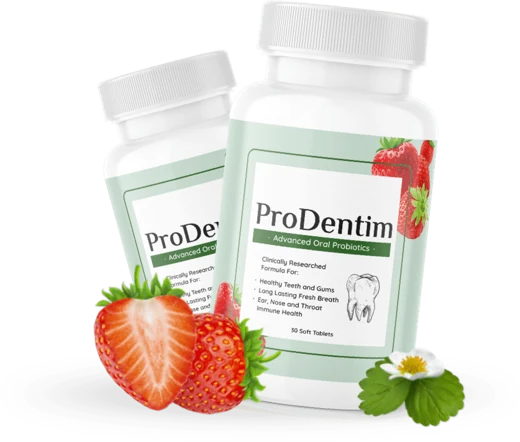
ProDentim is a chewable soft tablet that puts four kinds of probiotic bacteria and a fiber called inulin into the mouth, where it is meant to dissolve slowly. The sales page calls it a “Brand New” probiotic “Specially Designed For The Health Of Your Teeth And Gums” and promises fresher breath and healthier gums[1].
The pitch starts with a story. The page says a “May 2022” study in a Springer Nature publication found that people with good teeth carry more good bacteria in the mouth. It then says that many toothpastes and mouthwashes “contain toxic ingredients that can destroy the microbiome in the mouth”[1]. The linked reference is a news item, not a trial of ProDentim.

The label on the bottle tells you to take the tablet “ideally after brushing teeth or using mouthwash”[3]. So the tablet is meant to follow the same products the sales page criticizes.
The page also shows a count of “95,000 reviews,” a line saying 97% of customers order 6 bottles, and three “Verified Purchase” testimonials. None of these names a platform, date or way to check them[1]. We treat them as marketing.
The label says the product is made in a “FDA Registered Facility” and is “GMP Certified”[3]. The FAQ goes further and describes the plant as FDA approved, while the same FAQ admits that the FDA is not authorized to review dietary supplements[4]. Registration only means a plant is on file. NCCIH notes that supplements do not need FDA approval before they are sold[6].
How is ProDentim supposed to work?
The vendor’s idea is that adding friendly bacteria to the mouth crowds out the bacteria linked to plaque, bad breath and sore gums. That idea is studied in dentistry, but the results depend on the exact strain, and no study has tested the ProDentim tablet in people.
Dental plaque is “a sticky film of bacteria,” and gum disease begins when that film inflames the gums[8]. Researchers have tried oral probiotics to shift that bacterial mix, usually as lozenges or milk, and often as an add-on to a professional cleaning[13].
Two federal sources set the ground rules. The NIH Office of Dietary Supplements says a probiotic label should name the genus, species and strain, and that “higher CFU counts alone do not necessarily mean that the product has greater health benefits”[5]. NCCIH says that “in most instances, we still don’t know which probiotics are helpful and which are not”[6].
ProDentim gives a strain code for only one of its four bacteria, B. lactis BL-04[3]. For the other three, you cannot match the tablet to the strains used in trials. So the research below is only a rough guide.
The FAQ also adds claims that go well past oral health, such as “a powerful, deep toxin cleanse” and help for sinuses, allergies and sleep[4]. We found no human research that links these ingredients, at these doses, to any of those outcomes.
What ingredients are in ProDentim?
Each tablet lists 100 mg of inulin, a 20 mg blend of L. paracasei, L. reuteri and B. lactis BL-04 with 3.5 billion CFU at the time of manufacture, and 20 mg of S. salivarius. Tricalcium phosphate, strawberry flavor and peppermint oil are listed as other ingredients with no amounts[3].
The label and the sales page do not match. The sales page promotes malic acid, which is not on the label. It never mentions S. salivarius, which is on the label. And an FAQ answer talks about “3” strains while the label lists four bacteria[1][3]. We go by the label, since that is what is in the bottle.
| Ingredient | Label amount | Best human evidence | Grade |
|---|---|---|---|
| Lactobacillus paracasei | Part of 20 mg blend | Strain SD1 in milk cut new cavities in young children; another strain did nothing in adults[14][15] | Limited |
| Lactobacillus reuteri | Part of 20 mg blend | Lozenges helped pockets after deep cleaning; reviews call the evidence limited[18][19] | Limited |
| Bifidobacterium lactis BL-04 | Part of 20 mg blend | A sister strain, HN019, helped with scaling and gum bleeding; no BL-04 oral trial found[16][17] | Limited |
| Streptococcus salivarius | 20 mg, no CFU | Bad breath trials mixed; one gum trial positive[20][21][22] | Limited |
| Inulin (chicory root) | 100 mg | No oral-health trial; 33 trials on other outcomes[24] | Weak |
| Peppermint oil, tricalcium phosphate | Not stated | Flavor and filler amounts; no oral-health trial as swallowed ingredients[25] | Weak |
Lactobacillus paracasei
The best result comes from a strain called SD1. In a 2018 trial, 124 children aged 1.5 to 5 drank milk with SD1 once a day for 3 months and had fewer new cavities than children on standard milk[14]. A different strain, GMNL-33, was given to 78 adults as tablets three times a day for 2 weeks and did no better than placebo[15]. ProDentim does not say which strain it uses.
Lactobacillus reuteri
This is the most studied oral probiotic. In a 2013 trial, 30 people with periodontitis sucked L. reuteri lozenges twice a day for 12 weeks after a full-mouth cleaning, and their deeper gum pockets shrank more than with placebo[18]. A 2024 review of 11 trials still rated the evidence as limited, with a high or unclear risk of bias[19]. In a pooled gingivitis analysis, L. reuteri did not change gum or plaque scores in a meaningful way[12].
Bifidobacterium lactis BL-04
We found no oral-health trial of BL-04 itself. A related strain, HN019, was given as a lozenge twice a day alongside scaling and root planing, and people had better pocket depth and gum attachment at 90 days[16]. HN019 also reduced gum bleeding in a gingivitis trial[17]. Results from one strain do not carry over to another, so this is a hint, not proof.
Streptococcus salivarius
This bacterium lives in a healthy mouth, and strains K12 and M18 are sold as breath and gum lozenges. In a 2020 trial, 28 people with bad breath took K12 daily for 30 days; their scores fell, but no more than with placebo[20]. A pooled look at 3 trials found lower odor scores by sniff test but no change in the sulfur gases that cause the smell[21]. M18 lowered a gum inflammation score in young adults[22]. ProDentim names neither strain and gives no CFU count for this ingredient[3].
Inulin
Inulin is a plant fiber from chicory root that feeds gut bacteria. A review of 33 trials looked at its effects on weight and heart health markers[24], but we found no trial that tested inulin for teeth or gums. At 100 mg, the dose is far below the gram-sized amounts used in fiber research.
Peppermint oil and tricalcium phosphate
Both are listed as other ingredients with no amounts[3]. Peppermint gives flavor; NCCIH says there is not enough evidence that it helps most conditions, and oral peppermint oil can cause heartburn in some people[25]. Tricalcium phosphate is a common filler and calcium source. The sales page links it to strong teeth, but we found no trial of it swallowed in a tablet for that purpose.
Malic acid (sales page only)
The sales page credits malic acid “in strawberries” with keeping teeth white, yet malic acid is not on the label[1][3]. Its best evidence is for a 1% mouth spray in dry mouth: 5 trials with 244 people found better saliva flow[23]. That was a spray, not a tablet.
See the current ProDentim price
Does ProDentim work for teeth and gums?
There is no published trial of ProDentim, so nobody can say how well it works. Research on oral probiotics in general shows small benefits for gum bleeding, mostly when they are added to a dental cleaning. Reviews call that evidence weak or limited, and the benefits have not been shown for cavities in adults.
| Review | Size | Finding |
|---|---|---|
| Akram, 2020 | 10 double-blind trials | “Weak evidence” for probiotics in gingivitis[12] |
| Gruner, 2016 | 50 studies, 3,247 people | Less gum bleeding; no clear drop in cavities; high risk of bias[27] |
| Benavides-Reyes, 2025 | 24 studies | Lower plaque and bleeding in periodontitis as an add-on to cleaning; not significant in gingivitis[13] |
| European Federation of Periodontology, 2020 | 5 trials, 176 people | 0.38 mm extra pocket reduction at 6 months; advises against probiotics as an add-on[11] |
The European periodontal guideline is the most cautious. It found an average gain of 0.38 mm in pocket depth, too small to matter in practice, and suggested that dentists not use probiotics alongside deep cleaning[11].
Most of these trials used named strains in lozenges at about a billion CFU or more per dose, so the results cannot be applied to an unnamed blend[16][18]. Many also gave the probiotic after a professional cleaning, which a tablet bought online does not include.
Early gum disease “can often be reversed by daily brushing and flossing,” according to the NIH dental institute[8]. MedlinePlus adds that untreated gingivitis can lead to periodontitis[9]. A tablet is not a stand-in for those steps or for a dentist visit.
Does ProDentim help with bad breath?
The evidence for bad breath is thin. The closest ingredient, S. salivarius K12, did no better than placebo in a 30-day trial, and a pooled look at 3 trials found no change in the sulfur gases that cause the smell[20][21]. ProDentim does not even say which S. salivarius strain it contains.
Peppermint oil in the tablet will freshen the mouth for a short time, as any mint does[3]. That is a flavor effect. Most bad breath comes from the tongue coating, gum disease or dry mouth, so a dentist can usually find the source.
If your breath problem is new or comes with bleeding gums, see a dentist. Red, swollen gums that bleed easily are the first sign of gingivitis, per MedlinePlus[9].
What are the ProDentim side effects, and who should skip it?
For most healthy adults, oral probiotics are well tolerated, and the trials of these species reported no serious side effects. The real risks are for people with weak immune systems, those who are seriously ill, and anyone pregnant, nursing or taking regular medicine, who the label itself tells to ask a provider first[3][6].
- Weak immune system or serious illness: NCCIH warns that probiotics carry a higher risk of serious infection in people who are severely ill or immunocompromised[6].
- Pregnancy and nursing: the label asks you to check with a provider first[3].
- Medicines: the label gives the same advice for anyone on medication[3]. Antibiotics can also kill the bacteria in a probiotic, so ask a pharmacist about timing.
- Heartburn: peppermint oil can trigger heartburn in some people[25].
- Gas or bloating: inulin is a fiber; 100 mg is a small amount, but sensitive people may notice it[24].
- Children: the label says to keep it out of the reach of children[3], despite an FAQ claim that it was “designed for all ages”[4].
NCCIH also notes that some probiotic products have been found to contain microbes other than those on the label[6]. ProDentim names no manufacturer and offers no lab report, so you cannot check this for yourself.
See the current ProDentim price
What is the ProDentim price per bottle?
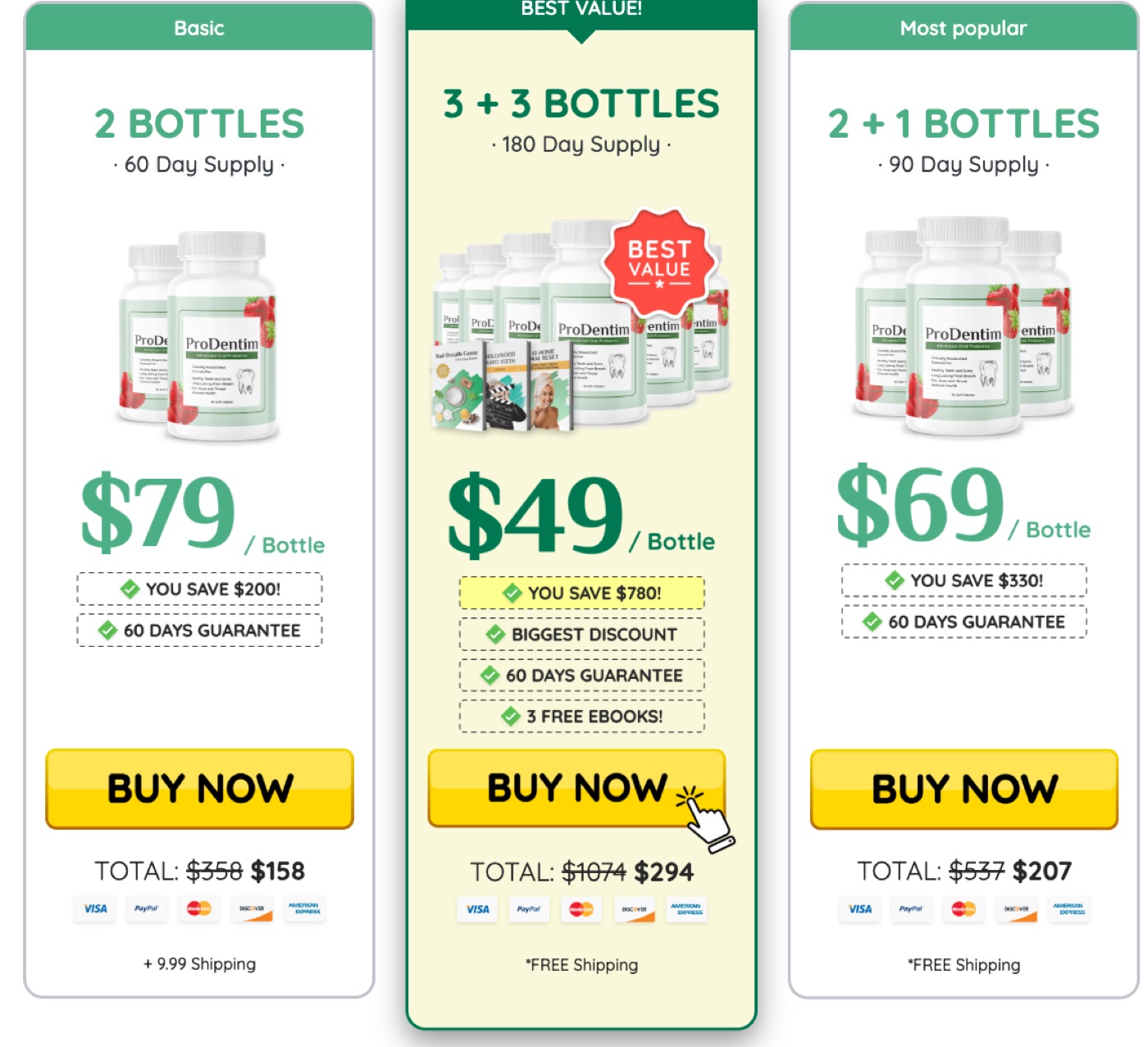
ProDentim costs $49 a bottle on the 6-bottle package ($294), $69 a bottle on 3 bottles ($207) and $79 a bottle on 2 bottles ($158 plus $9.99 shipping). The 3 and 6 bottle packages ship free in the US. These were the prices on the sales page on October 20, 2026[1].
Lowest price per bottle
6 bottles
$49 a bottle
$294 total, 180-day supply, free US shipping
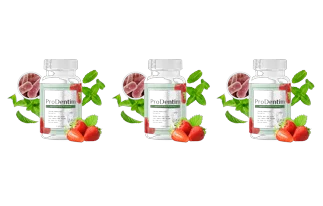

The page shows “was” prices of $358, $537 and $1,074 next to each package[1]. Those are the vendor’s own reference prices, and we did not see the product sold at them anywhere.
Here is the cost per day at one tablet a day. Two bottles with shipping come to $167.99, or about $2.80 a day over 60 days. Three bottles cost about $2.30 a day, and six cost about $1.63 a day[1]. The label allows up to two tablets a day, which would make each bottle last 15 days and double those daily costs[3].
Prices on this kind of page can change by visit. On October 19, a different version of the page offered a single bottle for $69[1]. Check the total at checkout before you pay. The FAQ says it is a one-time payment with no repeat shipments[4].
How to try it with the least risk:
- Start with the smallest package you are happy to lose if the refund does not go smoothly.
- Decline any extra bottles offered after checkout unless you planned for them.
- Write down the delivery date; the 60-day window starts then[2].
- Set a reminder for about day 45, so you have time to email and post the bottles back.
- Keep every bottle, empty or not, and the packing slip.
- Keep the receipt and your order number from the ClickBank email.
Does ProDentim have a money-back guarantee?
Yes. The refund policy gives you 60 days from the moment your package arrives to ask for your money back. You email support, then mail back all the bottles, empty or not, with the packing slip. You pay the return postage, and the refund takes 5 to 10 days to show on your statement[2].
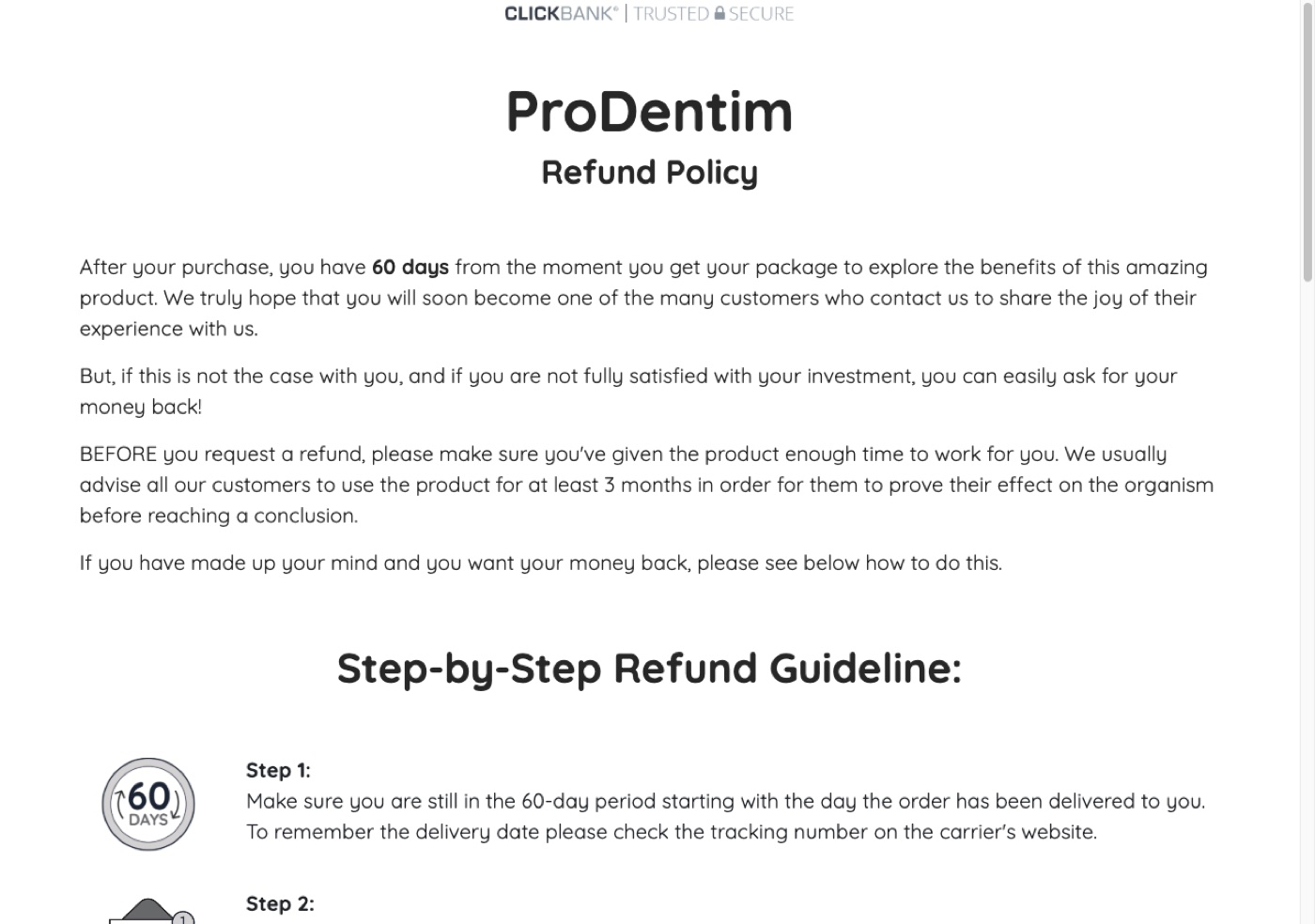
The steps on the refund page are:
- Make sure you are still inside 60 days from delivery[2].
- Email support with “Refund Request” in the subject line[2].
- Send all the bottles back to 285 Northeast Ave, Tallmadge, OH 44278, with a note giving your name, email and order number, plus the packing slip[2].
- Wait for processing; the money then takes 5 to 10 days to reach your card[2].
The same policy advises using the product “for at least 3 months” before deciding, which is longer than the 60-day window[2]. The FAQ says results take “around 9-12 weeks,” with no source[4]. And the ClickBank checkout that the sales page sends you to counts 60 days from the date of purchase, not delivery[1], so the safer plan is to count from the day you order.
Return shipping is not refunded[2]. On a 2-bottle order, that cost plus the $9.99 shipping you paid going out is money you will not get back.
Where to buy ProDentim?
Buy ProDentim only through the vendor’s own sales page at prodentim.com, where ClickBank processes the payment. That is the route the 60-day refund covers, and the FAQ says the product is not sold anywhere else[4].
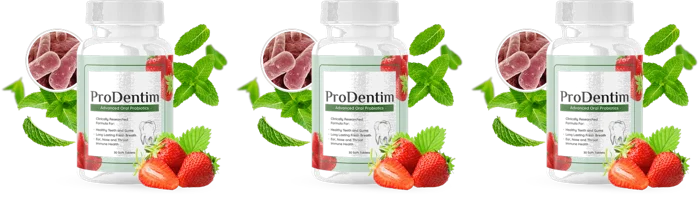
We found look-alike pages that use the ProDentim name with their own star ratings and big discount claims. Copies on marketplaces and look-alike sites fall outside the vendor’s refund, and their storage and supply chain cannot be checked. Your card statement should read CLKBANK*ProDentim; for order problems, ClickBank support is at 1-800-390-6035[4].
Check that the label on the bottle you receive matches the one described above: inulin, the three-bacteria blend and S. salivarius[3].
What do ProDentim reviews and complaints show?
The only ratings we could see were on the vendor’s own page, which claims 95,000 reviews and shows three testimonials with no platform named. Independent review sites gave us little to work with, so treat any large rating figure with care[1].
A Better Business Bureau search for “prodentim” on October 19, 2026 returned no ProDentim business profile, only unrelated dental businesses with similar names[26]. Trustpilot blocked our request, so we report no figures from it. The three testimonials come from Sam Perkin in Dallas, Portia Thompson in Florida and Theo Franklin in Chicago, each marked “Verified Purchase”[1]. The page does not say whether these results are typical.
Complaints about products sold this way tend to be about refunds: missed deadlines, return postage and bottles that were thrown away. Read the refund steps above before you order. For a worked example of how we sort real complaints from noise, see our look at Mitolyn reviews and complaints, which uses the same checks.
Which sales page claims deserve a second look?
Several ProDentim claims go further than any evidence we found: the attack on toothpaste and mouthwash, the toxin cleanse, the facility wording and the review counts. None is backed by a published trial of the product.
- Toothpaste and mouthwash “contain toxic ingredients”: the label tells you to take the tablet after brushing or mouthwash[3], and the ADA advises brushing twice a day[10].
- “Deep toxin cleanse that clears your entire body”: we found no study of these ingredients for this[4].
- A facility described as FDA approved: supplements and their plants are not approved by the FDA before sale[6].
- “Backed by clinical research”: the FTC says health claims need solid human trials, and none has tested ProDentim[7].
- “95,000 reviews” and “97%” of buyers choosing 6 bottles: no source is given[1].
We use the same checklist in our piece on whether Mitolyn is legit, if you want to see it applied to another product sold this way.
Are there cheaper evidence-based ways to care for your gums?
Yes. Brushing twice a day, cleaning between your teeth every day and regular dental cleanings have far stronger evidence than any probiotic tablet, and they cost less. The ADA and the NIH dental institute both put these first[8][10].
- Brush and clean between teeth. Early gum disease can often be reversed this way, per NIDCR[8].
- Get a professional cleaning. Gingivitis can usually be cleared by a cleaning plus good home care, says MedlinePlus[9].
- Treat deep pockets with your dentist. Scaling and root planing is the standard step for periodontitis[8].
- If you want a probiotic, pick a named strain. The NIH fact sheet says to look for the genus, species and strain on the label[5].
Chronic periodontitis affects 47.2% of US adults over 30, according to the ADA[10], so a checkup is worth more than any supplement. If you are comparing other probiotic products, our PrimeBiome review applies the same tests to a gut and skin gummy. For a product built around a different goal, see our Mitolyn review.
Who is ProDentim best for?
ProDentim suits a healthy adult who already brushes, flosses and sees a dentist, wants to try a dental probiotic, and will use the 60-day refund window. It does not suit anyone with a weak immune system, anyone hoping to replace dental care, or anyone pregnant, nursing or on regular medicine without a doctor’s OK.
The case for it is modest: a published label, a stated CFU count, a low-dose chewable with no stimulants and a written refund policy[2][3]. The case against it is that no trial has tested the tablet, three of four strains are unnamed, the sales page and label disagree, and the refund means posting every bottle back at your cost[1][2][3]. If you try it, buy the package you can afford to lose, note the order date, and keep every bottle until the window closes.
Best price we found
ProDentim: $49 a bottle on 6
- $294 for a 180-day supply with free US shipping
- $207 for 3 bottles, $158 plus shipping for 2
- Ordered through ClickBank on the vendor’s page
- 60-day refund from delivery; return all bottles
Prices checked October 20, 2026 on prodentim.com. Affiliate link.
Frequently asked questions
Where can I buy ProDentim?
Buy it only on the vendor's page at prodentim.com, where ClickBank processes the order. That is the route the 60-day refund covers. Marketplace and look-alike sellers fall outside that policy, and their storage and supply chain cannot be checked.
Does ProDentim have a money-back guarantee?
Yes. You have 60 days from delivery to email a refund request. You must mail back all bottles, empty or not, with the packing slip, and you pay return shipping. The refund shows on your card 5 to 10 days after processing.
What are the ProDentim side effects?
Trials of these probiotic species reported no serious side effects in healthy people. Peppermint oil can cause heartburn and inulin can cause gas. People with weak immune systems, serious illness, pregnancy or regular medicines should ask a doctor first.
How do you take ProDentim?
The label says to let one soft tablet dissolve in the mouth once or up to twice a day, ideally after brushing or mouthwash. The FAQ suggests one each morning. At two a day, a 30-tablet bottle lasts 15 days.
How long before ProDentim shows results, per the vendor?
The FAQ says supplements take around 9 to 12 weeks, and the refund policy advises 3 months of use. Neither cites a source, no trial of ProDentim exists, and both periods run past the 60-day refund window.
Is ProDentim legit?
ProDentim is a real product sold through ClickBank, a known retailer, with a written 60-day refund policy and a published label. No trial has tested it, three of its four strains are unnamed, and the sales page and label list different ingredients.
Sources
- ProDentim sales page. ProDentim (vendor), read October 20, 2026
- ProDentim refund policy. ProDentim (vendor), read October 20, 2026
- ProDentim Supplement Facts label. ProDentim (vendor), read October 19, 2026
- ProDentim contact and FAQ page. ProDentim (vendor), read October 19, 2026
- Probiotics: Fact Sheet for Consumers. NIH Office of Dietary Supplements, archived October 2026
- Probiotics: Usefulness and Safety. NCCIH, read October 2026
- Health Products Compliance Guidance. Federal Trade Commission, archived October 2026
- Periodontal (Gum) Disease. National Institute of Dental and Craniofacial Research (NIH)
- Gum Disease. MedlinePlus, National Library of Medicine
- Gum Disease. American Dental Association, MouthHealthy
- Treatment of stage I-III periodontitis: EFP S3 clinical practice guideline. Journal of Clinical Periodontology, 2020
- Clinical efficacy of probiotics in the treatment of gingivitis: systematic review and meta-analysis (Akram). Australian Dental Journal, 2020
- Clinical effects of probiotics on gingivitis and periodontitis: systematic review and meta-analysis (Benavides-Reyes). BMC Oral Health, 2025
- Lactobacillus paracasei SD1 milk and caries in preschool children: RCT (Pahumunto). Randomized trial, 2018
- Lactobacillus paracasei GMNL-33 tablets in adults: RCT (Chuang). Randomized trial, 2011
- Bifidobacterium lactis HN019 as an adjunct to scaling and root planing: RCT. Randomized trial, 2018
- Bifidobacterium lactis HN019 in gingivitis: RCT. Randomized trial, 2024
- Lactobacillus reuteri lozenges after full-mouth disinfection in periodontitis: RCT (Teughels). Journal of Clinical Periodontology, 2013
- Lactobacillus reuteri in periodontitis: systematic review of 11 RCTs. Systematic review, 2024
- Streptococcus salivarius K12 for halitosis: RCT (He). Randomized trial, 2020
- Probiotics for halitosis: meta-analysis of 3 RCTs. Meta-analysis, 2017
- Streptococcus salivarius M18 and gingival health in young adults: RCT. Randomized trial, 2023
- 1% malic acid spray for xerostomia: meta-analysis of 5 RCTs. Meta-analysis, 2021
- Inulin-type fructans and cardiometabolic health: meta-analysis of 33 RCTs. Meta-analysis, 2021
- Peppermint Oil. NCCIH
- BBB search results: prodentim. Better Business Bureau, read October 19, 2026
- Probiotics for managing caries and periodontitis: systematic review and meta-analysis (Gruner). Journal of Dentistry, 2016

Daniel Brooks is the Reviews Editor at ProveNutra. He reads every supplement facts panel line by line, checks each ingredient and dose against human research from the NIH Office of Dietary Supplements, NCCIH, PubMed and the Cochrane Library, and reads the refund policy and checkout terms before a review is published. Daniel is not a doctor, dietitian or pharmacist, and his reviews are not medical advice. He writes pros, cons and who a product suits, never scores. How we review supplements.
This article is general information, not medical advice. Dietary supplements are not reviewed by the FDA for safety or effectiveness before they are sold. Talk to your doctor before you start any supplement, especially if you are pregnant, nursing, take medication or have a health condition.