
This article contains affiliate links. If you buy through them we may earn a commission at no extra cost to you, and it never changes what we report. How we make money.
Igenics is a two-capsule eye blend of 12 disclosed ingredients, sold for $39 to $59 a bottle with a 180-day ClickBank refund. No trial has tested it, and despite its AREDS2 claim the zinc and vitamin E doses differ from the studied formula. A healthy adult who tracks the refund date can try it; anyone on blood thinners should ask a doctor first.
On this page
- What is Igenics and what does the vendor claim?
- How is Igenics supposed to work?
- What ingredients are in Igenics?
- Is Igenics the same as the AREDS2 formula?
- Does Igenics work for eye health and clearer vision?
- What are the Igenics side effects, and who should skip it?
- What is the Igenics price, and is there a discount?
- Does Igenics have a money-back guarantee?
- Where to buy Igenics: is the official website the only source?
- What do Igenics reviews and complaints show?
- Are there cheaper evidence-based options for eye health?
- Who is Igenics best for?
- FAQ
Igenics pros and cons
What we liked
- Every ingredient amount is printed on the label, with no proprietary blend
- Lutein 20 mg, zeaxanthin 10 mg and saffron 20 mg, the dose used in saffron trials
- 180-day refund window on ClickBank orders
- $39 a bottle on 6 bottles with free US shipping
- One-time charges, no subscription
Watch out for
- Not the AREDS2 recipe despite the AREDs-2 formula claim: zinc 20 mg and vitamin E 0.268 mg
- No published trial of Igenics itself
- Label errors in the zinc form and the vitamin A spelling
- Ginkgo plus turmeric with black pepper calls for a doctor check if you take blood thinners or daily medicines
- Return postage terms are not stated, and the store and ClickBank windows differ
This Igenics review covers what we could check on October 19 and 20, 2026: the sales page, the price cards, the ClickBank checkout terms, the brand store refund policy, the Supplement Facts label and the published human research on all 12 ingredients. ProveNutra reviews editor Daniel Brooks set each vendor claim beside that research and beside guidance from the National Eye Institute, the NIH and the FTC. Our method is on the page about how ProveNutra reviews supplements.
It is written for adults who are weighing $39 to $59 a bottle for an eye nutrient capsule. ProveNutra earns a commission if you buy through our links; it does not change what we report.
Best price we found
Igenics: $39 a bottle on 6
- Two capsules a day, 60 capsules in each bottle
- 12 ingredients, every amount printed on the label
- $234 for 6 bottles, with free US shipping on that package
- 180 days from purchase to ask ClickBank for a refund
Check today's price on the official site
Prices checked October 20, 2026 on visionbreakthrough.com. Affiliate link.
| What it is | A vegetable capsule eye nutrient blend by Science Genics, 60 capsules a bottle, 2 a day, sold through ClickBank[1][2] |
|---|---|
| Main claim (the vendor's) | “Plant-based vision support for healthier eyes” with an “AREDs-2 formula” and “12 clinically-backed ingredients”[1] |
| Ingredients | Vitamins A, C and E, zinc, copper, bilberry, turmeric, ginkgo, black pepper extract, lutein, saffron and zeaxanthin[2] |
| Doses | All 12 disclosed; no proprietary blend. Lutein 20 mg, zeaxanthin 10 mg, saffron 20 mg, vitamin E 0.268 mg[2] |
| Price | $59 for 1 bottle plus $9.99 shipping, $147 for 3, $234 for 6[1] |
| Guarantee | 180 days from purchase on ClickBank orders; the brand store gives 365 days on its own orders[1][3] |
| Who should avoid it | Anyone on blood thinners or daily medicines without a doctor's OK, pregnant or nursing people, and people with liver problems[18][20][21][24] |

What is Igenics and what does the vendor claim?
Igenics is a two-capsule daily supplement that mixes five vitamins and minerals with seven plant ingredients, sold as vision support. The sales page headline reads “Plant-based vision support for healthier eyes” and says the formula “unites 12 clinically-backed ingredients that support healthier eyesight”[1].
The page lists four selling points: healthier vision “with AREDs-2 formula,” a healthy inflammatory response, more key vitamins and nutrients, and “Natural, Vegan ingredients and ZERO fillers”[1]. It calls ginkgo biloba “our main ingredient” and promises “Turmeric + Bioperine” for absorption[1].

The brand behind it is Science Genics, which lists an office at 2372 Morse Ave in Irvine, California, and a support line open Monday to Friday[6]. The sales page says Igenics is made “in a GMP certified facility right here in the US” and is “third party tested,” but it does not name the factory or the lab[1]. The brand store adds a physician, Dr. Charles Williams, as co-creator and quotes both “over 22,500 happy customers” and “10,000+” customers on the same site[4]. We could not verify either figure or the doctor's role.
Two details on the page do not match the label. The label says “black pepper extract,” with no BioPerine trademark and no piperine percentage. And by weight, ginkgo is third among the plants at 80 mg, behind bilberry at 480 mg and turmeric at 350 mg[1][2]. Trust the label on the bottle you receive.
How is Igenics supposed to work?
The vendor says Igenics supports clearer vision by “maintaining a healthy inflammatory response” and by supplying the nutrients from the AREDS2 eye study. Neither idea has been tested with this product. We found no published trial of Igenics, so any benefit has to be inferred from studies of its single ingredients.
The AREDS2 link is the core of the pitch. AREDS and AREDS2 were large National Eye Institute trials of high-dose vitamins and minerals in older adults[8]. The NEI says the formula helped only people who already had an intermediate or advanced stage of a specific age-related condition of the macula, the small central part of the retina used for sharp vision[8]. It was not shown to help healthy eyes or people at an early stage[8].
That matters for anyone buying Igenics for “clearer vision.” The studied goal was slowing a diagnosed condition over years. It was never sharper eyesight in a few weeks. The sales page goes further and calls these “vision restoring AREDs-2 ingredients”[1]. No AREDS result supports the word restoring.
The inflammation claim is even thinner. Turmeric, ginkgo and bilberry are often described as anti-inflammatory, but the human eye studies on them are small, and some are negative, as the ingredient section shows[17][19][20].
The FTC expects health claims in ads to rest on competent and reliable scientific evidence, generally randomized controlled trials on the product or one that is essentially the same[29]. A mix of 12 ingredients at its own doses is not the same as the AREDS2 pill. That does not prove Igenics does nothing. It does mean the vision claims come from marketing, with no test results behind them.
What ingredients are in Igenics?
Each two-capsule serving of Igenics lists 12 ingredients with every amount disclosed, which is more than many eye supplements show. The only other ingredient is the vegetable capsule shell, hypromellose[2]. The label also has two printing errors worth knowing about before you compare products.
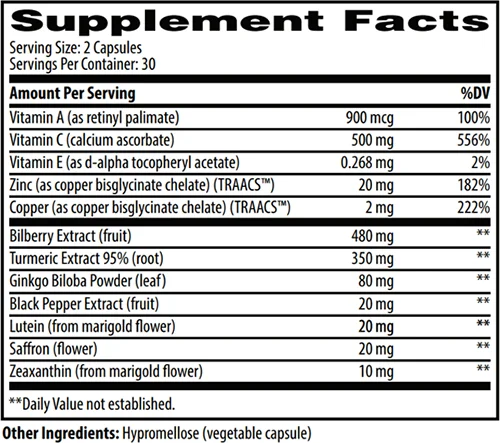
First, the zinc line names its form as “copper bisglycinate chelate,” the same form printed for copper. That is most likely a typo for zinc bisglycinate, but as printed it is wrong. Second, vitamin A is listed “as retinyl palimate,” a misspelling of retinyl palmitate[2]. Some pages that resell Igenics list beta-carotene instead; the vendor label does not contain beta-carotene[2].
| Ingredient and amount | Best human evidence | How the dose compares | Grade |
|---|---|---|---|
| Lutein 20 mg | Part of AREDS2; 12-month trial of 10 mg in 90 people[10][12] | Twice the AREDS2 amount | Moderate in AREDS2; weak alone |
| Zeaxanthin 10 mg | Part of AREDS2; 1-year trial of 8 mg in 60 men[10][13] | Five times the AREDS2 amount | Moderate in AREDS2; weak alone |
| Vitamin C 500 mg | Part of AREDS and AREDS2[8][9] | Same as AREDS2 | Moderate in the full formula |
| Zinc 20 mg | Part of AREDS and AREDS2 at 80 mg[8][10] | A quarter of the AREDS2 amount | Moderate in the full formula |
| Copper 2 mg | Added in AREDS to offset high zinc[8][26] | Same as AREDS2 | Supportive only |
| Vitamin E 0.268 mg | Part of AREDS and AREDS2 at 400 IU[8][25] | Less than 1% of the AREDS2 amount | None at this dose |
| Saffron 20 mg | Two small 3-month crossover trials at 20 mg[14][15] | Same as the trials | Limited |
| Bilberry 480 mg | Review of 30 trials; best trials negative[17][16] | Three times the NCCIH safety reference | Weak |
| Ginkgo 80 mg | Two small trials, 119 people[19] | Below the 120 to 240 mg often studied | Weak |
| Turmeric extract 350 mg | No controlled eye trial found[20] | Below the 500 to 1,500 mg used in other trials | Weak |
| Black pepper extract 20 mg | Raises absorption of curcumin and of some drugs[22][23] | Same as the absorption studies | Not an eye ingredient |
| Vitamin A 900 mcg | No eye benefit shown in people who are not deficient[24] | 100% of the daily value | Weak |
Lutein and zeaxanthin
These two yellow plant pigments collect in the macula. In AREDS2, 4,203 older adults took 10 mg of lutein and 2 mg of zeaxanthin on top of the other nutrients for 5 years, and the addition gave no further overall benefit (hazard ratio 0.90)[10]. Compared with beta-carotene, though, the pair did better, so they replaced it in the final formula[8]. Smaller trials found that 10 mg of lutein for 12 months raised macular pigment in 90 people, and 8 mg of zeaxanthin for a year did the same in 60 older men[12][13]. All of these people had an existing macula condition. Igenics gives 20 mg and 10 mg, more than AREDS2, and no trial shows that more is better.
Vitamin C, zinc, copper and vitamin E
These are the original AREDS nutrients. In AREDS, 3,640 people aged 55 to 80 took vitamins C and E, beta-carotene, zinc and copper for about 6 years; the full combination lowered the odds of progressing to the advanced stage (odds ratio 0.72)[9]. A 2023 Cochrane review of 26 studies and 11,952 people reached the same estimate, mostly from AREDS, with moderate certainty[11]. Igenics matches the 500 mg of vitamin C and the 2 mg of copper. Its zinc, at 20 mg, is a quarter of the 80 mg in AREDS2; AREDS2 found that 25 mg did not reduce the benefit, but 20 mg itself was not tested[10]. Its vitamin E, at 0.268 mg, is less than 1% of the 400 IU (180 mg) in the formula[25][8].
Saffron
Saffron at 20 mg a day is the best-matched plant ingredient in the formula. A 3-month crossover trial in 25 people with an early-stage macula condition found better retinal responses on an electrical test[14]. A later crossover trial found an average gain of 0.69 letters on an eye chart after 3 months, a small change[15]. Both trials were short and measured function, not long-term outcomes.
Bilberry
Bilberry has a long reputation for night vision, but a review of 30 trials found that the four most recent randomized trials were all negative, and positive results came from weaker studies[17]. NCCIH says the most rigorous studies found no night-vision benefit in healthy people[16]. NCCIH also says extract doses up to 160 mg a day have been used safely for 6 months[16]. Igenics has 480 mg, and the NCCIH page does not describe safety at that amount.
Ginkgo biloba
A Cochrane review found only two small trials, with 119 people, of ginkgo for an age-related macula condition, and said the question of benefit “has not been answered”[19]. Those trials used 60 to 240 mg a day for 6 months[19]. NCCIH notes that ginkgo may raise bleeding risk with blood thinners such as warfarin and may be unsafe in pregnancy[18].
Turmeric and black pepper extract
We found no controlled trial of turmeric for any eye goal, and NCCIH says plain turmeric is likely safe for 2 to 3 months[20]. The catch is the pairing. Black pepper extract raises curcumin absorption, and NCCIH and LiverTox both link high-absorption turmeric products to rare liver injury[20][21]. Piperine at 20 mg a day also raised blood levels of carbamazepine, propranolol and theophylline in volunteers[22][23].
Vitamin A
Igenics gives 900 mcg of preformed vitamin A, 100% of the daily value[2]. That is well below the adult upper limit of 3,000 mcg, but it adds to vitamin A from multivitamins, fortified foods and liver[24]. The NIH warns that pregnant people should not exceed that limit from supplements[24].
Is Igenics the same as the AREDS2 formula?
No. Igenics shares some AREDS2 nutrients, but its zinc, vitamin E, lutein and zeaxanthin amounts differ from the formula the National Eye Institute tested. The NEI says a product can only claim to match the AREDS2 doses; it endorses no brand, and ordinary multivitamins do not match them[8].
| Nutrient | AREDS2 formula | Igenics | Match? |
|---|---|---|---|
| Vitamin C | 500 mg[8] | 500 mg[2] | Yes |
| Vitamin E | 400 IU (180 mg)[8][25] | 0.268 mg[2] | No, under 1% |
| Zinc | 80 mg[8] | 20 mg[2] | No, a quarter |
| Copper | 2 mg[8] | 2 mg[2] | Yes |
| Lutein | 10 mg[8] | 20 mg[2] | No, double |
| Zeaxanthin | 2 mg[8] | 10 mg[2] | No, five times |
| Beta-carotene | None[8] | None[2] | Yes |
Two of the gaps cut in different directions. The low zinc and vitamin E mean Igenics is not the dose that was studied. The extra lutein and zeaxanthin mean it gives more of two nutrients than the trial did, with no trial showing that the extra helps.
If an eye doctor has told you to take an AREDS2 supplement, take one that matches the table above exactly. Igenics is a different product, and the extra herbs do not make up for missing doses.
Does Igenics work for eye health and clearer vision?
No study has tested Igenics, so nobody can say from evidence that it improves vision. Its best-supported nutrients, lutein, zeaxanthin, vitamin C, zinc and copper, were studied for slowing an existing macula condition, not for sharper eyesight in healthy adults. Saffron has small short trials; bilberry, ginkgo and turmeric are weak for eyes[8][15][17][19].
If you already have the specific condition AREDS studied, an eye doctor may recommend the exact AREDS2 formula, and that recommendation rests on two large trials and a Cochrane review[9][10][11]. If your eyes are healthy, the NEI says these nutrients have not been shown to prevent problems[8].
Some common reasons people look for an eye supplement, such as tired eyes after screen time, blurry reading or trouble seeing at night, have other causes. A new glasses prescription, better lighting or a check for a medical cause will do more. Bilberry was the classic night-vision herb, and its best trials found nothing[17][16].
The vendor does not say how long to wait for results, and we found no timeline backed by data. The saffron trials ran for 3 months, and the AREDS trials ran for 5 years or more[14][15][9]. Judge any change you notice with an eye exam, not by feel.
What are the Igenics side effects, and who should skip it?
Most healthy adults are unlikely to have problems at these doses, but ginkgo, turmeric with black pepper and vitamin A each carry cautions. The main ones are bleeding risk with blood thinners, drug interactions from piperine, rare liver injury with high-absorption turmeric, and vitamin A limits in pregnancy[18][22][21][24].
Reported side effects for the plant ingredients are mostly mild: ginkgo can cause dizziness, stomach upset and headache[18], and high doses of vitamin C can cause stomach upset[28]. Zinc at 20 mg is under the adult upper limit of 40 mg a day[27], and copper at 2 mg is under its 10 mg limit[26]. Check your multivitamin, since its zinc and vitamin A add to these amounts.
Skip Igenics, or ask a doctor or pharmacist first, if any of these apply:
- Blood thinners or antiplatelet drugs: ginkgo may raise bleeding risk with warfarin and similar drugs, and turmeric adds to that concern[18][20].
- Daily prescription medicines: black pepper extract changed blood levels of carbamazepine, propranolol and theophylline in volunteer studies[22][23].
- Liver problems: LiverTox links high-absorption turmeric products to liver injury, usually 1 to 4 months after starting[21].
- Pregnancy or breastfeeding: NCCIH says ginkgo and turmeric may be unsafe in pregnancy, and the NIH sets limits on preformed vitamin A[18][20][24].
- Surgery coming up: stop ginkgo ahead of time and tell your surgeon, because of the bleeding risk[18].
- Retinoid acne or skin drugs: extra vitamin A adds to their effects[24].
If you notice yellowing skin or eyes, dark urine, unusual bruising or bleeding, stop taking the capsules and call your doctor. And if your vision changes suddenly, see an eye doctor that day rather than reaching for a supplement.
What is the Igenics price, and is there a discount?
Igenics costs $59 for one bottle plus $9.99 shipping, $147 for three and $234 for six, so the lowest price is $39 a bottle on the 6-bottle package. These are the vendor's own package discounts from its struck-through “was” totals of $149, $447 and $894; we found no separate coupon or sale code[1].

Lowest price per bottle
6 bottles
$39 a bottle
$234 total, 180-day supply, free US shipping

At two capsules a day, that is about $2.30 a day on one bottle with shipping, $1.63 on three and $1.30 on six[1]. All orders are one-time charges with no subscription, and the card statement shows CLKBANK*ScienceGenics[1]. On October 19 an exit pop-up also offered 2 bottles plus 1 free for $118, which works out to $39.33 a bottle on three[1].
The bonuses differ by package. Three bottles add two ebooks. Six bottles add two ebooks and one bottle of Intelligen, a different Science Genics product, not more Igenics[1]. One price card shows “$9.99 Shipping” under the 3-bottle button while also printing “free shipping”; the checkout we read charged $0 on that package[1]. Check the total before you pay. Extra bottle offers may appear after checkout; decline any you did not plan for.
For comparison, store-brand AREDS2 capsules often cost less per month, and they match the studied doses. Price both before you decide. If you still want to try Igenics, the lowest-risk way is:
- Buy one bottle, or three if you want the lower price and accept a bigger return.
- Save the order number and the email from ClickBank.
- Set a reminder for day 150 after purchase, well inside the 180-day window.
- Keep every bottle, opened or empty, with the packing slip.
- Book an eye exam before you start and compare after a few months, so you judge change by more than memory.
Does Igenics have a money-back guarantee?
Yes. Orders placed through the Igenics sales page are covered by ClickBank's 180-day refund window from the date of purchase. The brand's own store, sciencegenics.com, advertises 365 days on orders placed there, so the window depends on where you bought[1][3].

The screenshot above is the store policy, which says products bought on ScienceGenics.com “are eligible for return within the first 365 days of receipt” and that you must email support for authorization before sending anything back[3]. Returns sent without authorization are not processed[3]. That policy applies to store orders, not to orders placed through visionbreakthrough.com.
For a ClickBank order, which is what our links lead to, the steps are:
- Find your order number in the ClickBank receipt email.
- Request the refund at clkbank.com with that number and your email, or call ClickBank at 1-800-390-6035[7][1].
- If you are asked to return product, send it to the return address on the sales page: Science Genics Shipping, 285 Northeast Ave, Tallmadge, Ohio 44278[1].
- Keep the tracking number for the return.
Two things are not stated anywhere we looked: who pays return shipping, and whether opened or empty bottles count[1][3]. Assume you pay postage until support tells you otherwise. If you bought six bottles, ask how the free Intelligen bottle is handled in a refund.
Where to buy Igenics: is the official website the only source?
The safest place to buy Igenics is its official website, visionbreakthrough.com, where ClickBank processes the payment and the 180-day refund applies. The brand also sells it on sciencegenics.com at different prices and under a 365-day store policy; store orders ship within 2 to 3 business days, free on 6 bottles[1][3][5].
Copies on marketplaces fall outside both policies, and you cannot check how they were stored. We also saw resale pages that list beta-carotene instead of the vendor's vitamin A form, quote prices that differ from the checkout and claim the product is FDA approved[2]. The FDA does not approve dietary supplements. Rely on the label on the bottle and the price on the official checkout.
The same rule applies to any supplement sold this way. Our guide to why buying Mitolyn from its official website matters walks through the retailer and refund checks in more detail.
Visit the official Igenics site
What do Igenics reviews and complaints show?
We found no independent customer reviews we could read and verify: no BBB profile, no readable Trustpilot page and no testimonials on the sales page. The Igenics review data that exists is either the brand's own or could not be loaded, so treat star ratings you see elsewhere with care[30][1].
Here is what we checked on October 19, 2026:
- BBB: searches for “igenics” and “science genics” returned no profile for the product or the company[30].
- Trustpilot: the pages for visionbreakthrough.com and sciencegenics.com blocked our request, and an archived copy was not available. We have no Trustpilot data.
- Sales page: no customer testimonials, only a testimonials disclaimer in the footer[1].
- Brand store: one repeated quote with no product named and no date, plus two different customer counts[4].
- FDA: the public recall and adverse event databases showed no records naming Igenics. We did not check FDA warning letters.
The complaint points we can see come from the terms themselves: two guarantee lengths, an unstated return postage rule, and a 6-bottle bonus that includes a different product. None of that is unusual for ClickBank supplements, but each one can cause friction at refund time.
For a fuller method of reading supplement complaints, see how we handled Mitolyn reviews and complaints, and our checklist on whether a supplement like Mitolyn is legit.
Are there cheaper evidence-based options for eye health?
Yes. For most adults, a regular dilated eye exam, a diet rich in leafy greens, and, only if an eye doctor advises it, a store-brand AREDS2 supplement are the evidence-based steps. The NEI says the AREDS2 formula helps only people with the specific condition it studied, and that multivitamins do not match its doses[8].
- Get an eye exam first. It tells you whether you have the condition AREDS2 was studied for, which decides whether the formula is worth taking[8].
- Eat lutein and zeaxanthin as food. Leafy greens and egg yolks supply them. AREDS2 found the largest effect in people who ate the least of them[8].
- If advised, match the AREDS2 label. 500 mg vitamin C, 400 IU vitamin E, 80 mg zinc, 2 mg copper, 10 mg lutein and 2 mg zeaxanthin[8].
- If you smoke or used to, avoid beta-carotene. AREDS2 dropped it after a safety signal in former smokers[10].
- For tired eyes at screens, a correct prescription and regular breaks do more than any herb in this formula.
None of these need a 6-bottle order. Igenics may still appeal to someone who wants saffron and extra lutein in one capsule, but it is not the cheaper or the better-tested choice.
Who is Igenics best for?
Igenics suits a healthy adult who wants a lutein, zeaxanthin and saffron blend, takes no blood thinners or daily medicines, and will track a 180-day refund deadline. It is a poor fit for anyone told to take AREDS2, since the doses differ, and for anyone pregnant or with liver problems[8][2][18][21].
Our honest read: the label is fuller than most, the refund window is long, and the 6-bottle price drops to $39 a bottle[2][1]. Against that, the “AREDs-2 formula” line overstates the match, no trial has tested the product, and three of the herbs have weak eye evidence. For most people worried about their eyes, an eye exam and a matched AREDS2 formula, if advised, are the better first step because they rest on the large trials. If you still want to try Igenics, start with one or three bottles, keep everything and decide well before day 180.
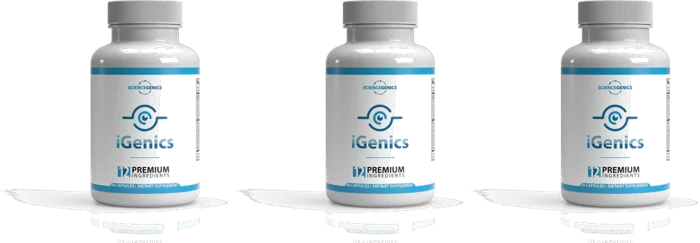
If you decide to try it
Igenics: from $39 a bottle
- $59, $147 or $234 for 1, 3 or 6 bottles
- 180 days from purchase to request a refund through ClickBank
- Return postage terms not stated; ask support first
- Ask a doctor first if you take daily medicine
Visit the official Igenics site
Prices checked October 20, 2026 on visionbreakthrough.com. Affiliate link.
Frequently asked questions
Where can I buy Igenics?
Buy it on the official website, visionbreakthrough.com, where ClickBank processes the payment and the 180-day refund applies. The brand store sciencegenics.com sells it too, under a 365-day store policy. Marketplace copies fall outside both refund policies.
Does Igenics have a money-back guarantee?
Yes. ClickBank orders can be refunded within 180 days of purchase through clkbank.com or 1-800-390-6035. Store orders get 365 days from receipt, but you must email support for authorization first. Who pays return postage is not stated.
What are the Igenics side effects?
Most people are unlikely to have problems, but ginkgo can cause dizziness, headache or stomach upset and may raise bleeding risk with blood thinners. Black pepper extract can change drug levels, and high-absorption turmeric is linked to rare liver injury.
How do you take Igenics?
The label serving is two vegetable capsules a day, so one bottle of 60 capsules lasts 30 days. The sales page gives no timing advice. If you take daily medicine, ask a pharmacist before the first dose.
How long does Igenics take to work, per the vendor?
The vendor gives no timeline, and no study has tested Igenics. The saffron trials behind one ingredient ran for 3 months, and the AREDS trials ran for years, so a few weeks is too short to judge any change.
Is Igenics legit?
It is a real product from Science Genics LLC of Irvine, California, sold through ClickBank with a 180-day refund and a fully disclosed label. Its AREDS2 claim overstates the match, and no independent customer reviews could be verified.
Sources
- Igenics sales page, price grid and ClickBank checkout terms. Science Genics (vendor), read October 19 and 20, 2026
- Igenics Supplement Facts label. Science Genics (vendor), read October 19, 2026
- Science Genics store refund policy. Science Genics store, read October 20, 2026
- Science Genics store home page. Science Genics store, read October 19, 2026
- Science Genics shipping policy. Science Genics store, read October 19, 2026
- Science Genics contact page. Science Genics store, read October 19, 2026
- ClickBank Customer Service: order lookup and support. ClickBank, read October 20, 2026
- AREDS/AREDS2 frequently asked questions. National Eye Institute, read October 19, 2026
- Age-Related Eye Disease Study report 8: high-dose antioxidants and zinc. Archives of Ophthalmology, 2001
- AREDS2 randomized clinical trial of lutein, zeaxanthin and omega-3 fatty acids. JAMA, 2013
- Antioxidant vitamin and mineral supplements for slowing progression: Cochrane review. Cochrane Database of Systematic Reviews, 2023
- LAST trial: lutein 10 mg for 12 months. Optometry, 2004
- Zeaxanthin and Visual Function (ZVF) trial. Optometry, 2011
- Saffron 20 mg and retinal function: randomized crossover trial. Investigative Ophthalmology and Visual Science, 2010
- Saffron 20 mg and visual function: randomized crossover trial. Broadhead et al., 2019
- Bilberry. NCCIH, read October 19, 2026
- Bilberry and night vision: systematic review of 30 trials. Survey of Ophthalmology, 2004
- Ginkgo. NCCIH, read October 19, 2026
- Ginkgo biloba for the aging macula: Cochrane review. Cochrane Database of Systematic Reviews, 2013
- Turmeric. NCCIH, read October 19, 2026
- LiverTox: Turmeric. NIH LiverTox, archived copy, 2024
- Piperine and carbamazepine levels in volunteers. PubMed, 2016
- Piperine and propranolol and theophylline levels in volunteers. European Journal of Clinical Pharmacology, 1991
- Vitamin A: Fact Sheet for Health Professionals. NIH Office of Dietary Supplements, archived 2026
- Vitamin E: Fact Sheet for Health Professionals. NIH Office of Dietary Supplements, archived 2026
- Copper: Fact Sheet for Health Professionals. NIH Office of Dietary Supplements, archived 2026
- Zinc: Fact Sheet for Health Professionals. NIH Office of Dietary Supplements, 2026
- Vitamin C: Fact Sheet for Health Professionals. NIH Office of Dietary Supplements, archived 2026
- Health Products Compliance Guidance. Federal Trade Commission, archived October 2026
- BBB search results: igenics. Better Business Bureau, read October 19, 2026

Daniel Brooks is the Reviews Editor at ProveNutra. He reads every supplement facts panel line by line, checks each ingredient and dose against human research from the NIH Office of Dietary Supplements, NCCIH, PubMed and the Cochrane Library, and reads the refund policy and checkout terms before a review is published. Daniel is not a doctor, dietitian or pharmacist, and his reviews are not medical advice. He writes pros, cons and who a product suits, never scores. How we review supplements.
This article is general information, not medical advice. Dietary supplements are not reviewed by the FDA for safety or effectiveness before they are sold. Talk to your doctor before you start any supplement, especially if you are pregnant, nursing, take medication or have a health condition.